
Publicado el 3 de diciembre de 2013 | http://doi.org/10.5867/medwave.2013.11.5853
¿Los recordatorios a teléfonos móviles aumentan la asistencia a controles de salud previamente agendados?
Do mobile phone messaging reminders increase attendance at healthcare appointments?
Abstract
Failure to attend healthcare appointments impacts on patients' health and on health system costs. Sending patients appointment reminders using mobile phone text messaging (Short Message Service (SMS) and Multimedia Message Service (MMS) could improve attendance compared to no reminders, or other type of reminders such as postal or phone call reminders. Considering the broad penetration of cell phones in several low income countries, this alternative is particularly promising.
This summary is based on the following systematic review:
Car J, Gurol-Urganci I, de Jongh T, Vodopivec-Jamsek V, Atun R. Mobile phone messaging reminders for attendance at healthcare appointments. Cochrane Database of Systematic Reviews 2012, Issue 7. Art. No.: CD007458. DOI: 10.1002/14651858.CD007458.pub2
Key messages
- Mobile phone text message reminders compared with no reminders, or compared with phone calls reminders may lead to little or no difference in attendance at healthcare appointments.
- It is uncertain whether mobile phone reminders added to postal reminders compared with postal reminders alone improves attendance rate.
- No studies were found that evaluated the impact on health outcomes of mobile phone text message reminders compared with no reminders, or compared with phone call reminders, or added to postal reminders.
- All of the studies were from upper middle- or high- income countries.
Background
There are several possible modes of communicating reminders for healthcare appointments, such as face-to-face, postal message, call to landline, call to mobile, via web based electronic health records, email and SMS/MMS.
Considering the penetration of mobile phones has experienced a fast growth in many low- income countries, and is expected that other might go in the same direction, there is a lot of interest in mobile phone reminders for increasing attendance rate, and for a range of other health purposes.
Summary of findings
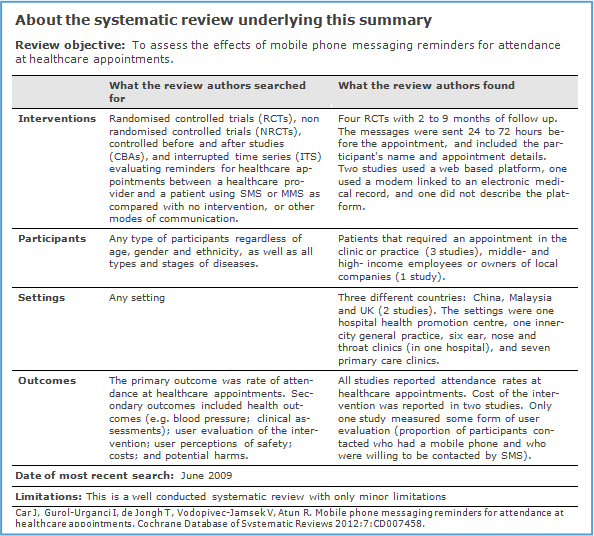
Four studies evaluated mobile phone text messaging against no reminder, or other types of reminder. The message were sent through a web platform or a modem linked to an electronic medical record, 24 to 72 hours before the appointment. They were conducted in 3 different countries and in different settings (primary, hospital, community, outpatient), and all studies reported attendance rates, but no study reported health outcomes.
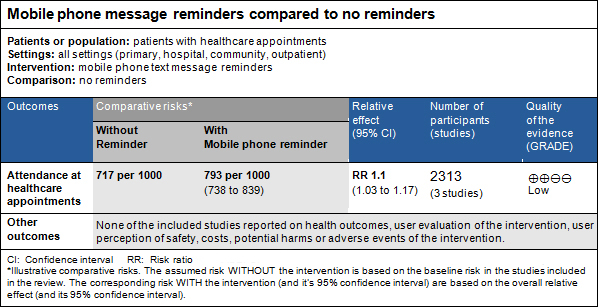
1) Mobile phone text message reminders compared to no reminders for patients with healthcare appointments- Mobile phone text message reminders compared with no reminders may lead to little or no difference in attendance at healthcare appointments.
- The certainty of the evidence is low. No studies were found that evaluated the impact of mobile phone text message reminders compared with no reminders on health outcomes, user evaluation of the intervention, user perception of safety, costs, potential harms or adverse events of the intervention. The certainty of the evidence is very low.
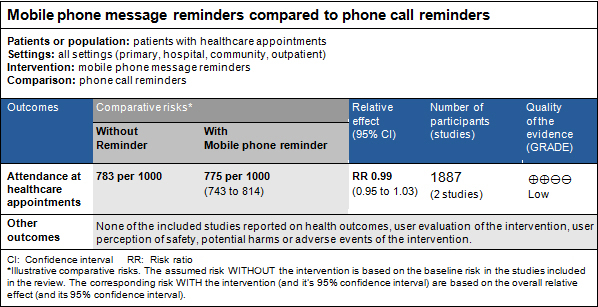
2) Mobile phone message reminders compared to phone call reminders for patients with healthcare appointments
- Mobile phone text message reminders compared to phone call reminders may lead to little or no difference in attendance at healthcare appointments. The certainty of the evidence is low.
- No studies were found that evaluated the impact of mobile phone text message reminders compared with phone calls on health outcomes, user evaluation of the intervention, user perception of safety, costs, or potential harms of the in-tervention. The certainty of the evidence is very low.
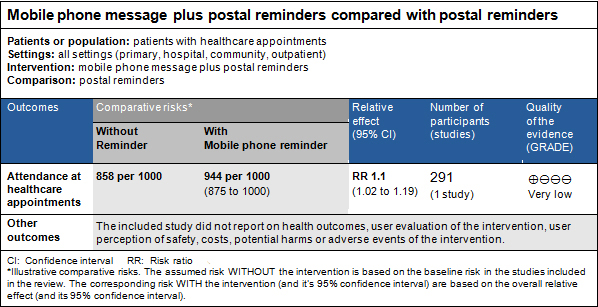
3) Mobile phone message reminders plus postal reminders compared to postal reminders alone for patients with healthcare appointments
- It is uncertain whether mobile phone text message reminders plus postal reminders compared to postal reminders improves attendance at healthcare appointments because the certainty of the evidence is very low.
- No studies were found that evaluated the impact of mobile phone message plus postal reminders compared with postal reminders alone on health outcomes, user evaluation of the intervention, user perception of safety, costs, or potential harms of the intervention. The certainty of the evidence is very low.
Relevance of the review for low- income countries
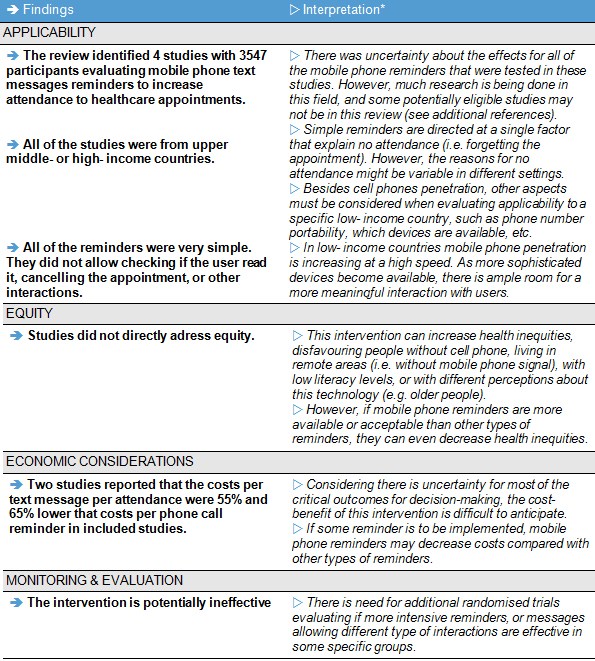
Notes
*About quality of evidence (GRADE)
The quality of the evidence is a judgement about the extent to which we can be confident that the estimates of effect are correct. These judgements are made using the GRADE system, and are provided for each outcome. The judgements are based on the type of study design (randomised trials versus observational studies), five factors that can lower confidence in an estimate of effect (risk of bias, inconsistency of the results across studies, indirectness, imprecision of the overall estimate across studies, and publication bias), and three factors that can increase confidence (a large effect, a dose response relationship, and plausible confounding that would increase confidence in an estimate).
- High: it is very likely that the effect will be close to what was found in the research.
- Moderate: it is likely that the effect will be close to what was found in the research, but there is a possibility that it will be substantially different.
- Low: it is likely that the effect will be substantially different from what was found in the research, but the research provides an indication of what might be expected.
- Very low: the anticipated effect is very uncertain and the research does not provide a reliable indication of what might be expected.
Related bibliography
James J. Penetration and Growth Rates of Mobile Phones in Developing Countries: An Analytical Classification. Soc Indic Res. 2010 Oct;99(1):135-145. doi: 10.1007/s11205-009-9572-0
Conflict of interests statement