
Estudios originales
← vista completaPublicado el 19 de agosto de 2026 | http://doi.org/10.5867/medwave.2026.07.3216
Eficacia y seguridad de la goserelina frente a la leuprolida en pacientes con cáncer de mama en fase premenopáusica que reciben terapia endocrina adyuvante: Un estudio de cohorte retrospectivo
Efficacy and safety of goserelin vs. leuprolide in premenopausal breast cancer patients receiving adjuvant endocrine therapy: A retrospective cohort study
Abstract
Introduction Goserelin and leuprolide are gonadotropin-releasing hormone (GnRH) agonists used for ovarian function suppression in premenopausal breast cancer patients. Whether their different molecular structures lead to clinically meaningful differences in efficacy and safety remains unclear.
Objectives To compare the efficacy and safety of goserelin versus leuprolide as adjuvant endocrine therapy (combined with tamoxifen) in premenopausal women with hormone receptor-positive breast cancer after curative surgery.
Methods This retrospective cohort study initially recruited 215 young cancer patients receiving adjuvant chemotherapy with tamoxifen combined with a gonadotropin-releasing hormone agonist. After applying inclusion and exclusion criteria, 187 patients were included and divided into two groups according to the gonadotropin-releasing hormone agonist they actually received: leuprolide (n=90) or goserelin (n=97). The primary efficacy outcome was the proportion of patients achieving substantial estrogen reduction (estradiol ≤30 pg/mL or falling into the pre-specified laboratory range) after 6 months. Secondary outcomes included liver function parameters and thyroid function parameters. Exploratory outcomes included changes from baseline to six months in testosterone, luteinizing hormone (LH), follicle-stimulating hormone (FSH), and prolactin levels, as well as descriptive assessment of the tumor marker carcinoembryonic antigen (CEA). Between-group differences were expressed as risk differences (RDs) with 95% confidence intervals (CIs).
Results Baseline demographic and cancer-related characteristics were balanced between the two groups. After six months of adjuvant therapy, the two groups showed similar primary efficacy: the proportion of patients with substantial estrogen reduction was 88.89% in the leuprolide group and 92.78% in the goserelin group (RD = −3.89%, 95% CI: −12.18% to 4.40%; p = 0.354). Regarding safety, the leuprolide group had a significantly higher rate of liver function abnormalities (30.00% vs. 13.40%; RD = 16.60%, 95% CI: 4.96% to 28.24%; p = 0.012), driven mainly by a lower rate of normal aspartate aminotransferase (AST) levels (85.56% vs. 96.91%; RD = −11.35%, 95% CI: −19.39% to −3.31%; p < 0.05). In contrast, the leuprolide group had a higher rate of normal thyroid function (88.89% vs. 76.29%; RD = 12.60%, 95% CI: 1.94% to 23.26%; p = 0.018), mainly due to a higher normal thyroid-stimulating hormone rate (93.33% vs. 83.51%; RD = 9.82%, 95% CI: 0.82% to 18.82%; p < 0.05). Carcinoembryonic antigen normalization rates were also comparable (93.33% vs. 92.78%; RD = 0.55%, 95% CI: −6.74% to 7.84%; p = 0.549).
Conclusions Leuprolide and goserelin demonstrate similar efficacy when used as adjuvant therapy in combination with tamoxifen for young women with breast cancer. However, leuprolide may pose a potential risk of hepatic impairment, whereas goserelin appears to be associated with a higher incidence of thyroid injury. These findings provide a theoretical basis for personalized clinical management in this patient population.
Main messages
- This study compared efficacy and safety between goserelin and leuprolide as gonadotropin-releasing hormone agonists combined with tamoxifen in postoperative adjuvant therapy for premenopausal breast cancer.
- The two drugs showed similar clinical efficacy in estrogen reduction and carcinoembryonic antigen normalization after six-month treatment.
- Leuprolide was linked to higher liver function abnormality, while goserelin carried higher thyroid function impairment risk.
- The findings support personalized medication selection; limitations include single-center, short follow-up, and lack of long-term survival data.
Introduction
Breast cancer ranks among the most common malignancies in women worldwide, and its management critically influences patient survival outcomes and quality of life [1]. For premenopausal patients, postoperative systemic adjuvant therapy is essential to reduce recurrence and improve survival [2]. Endocrine therapy, a cornerstone for hormone receptor-positive (ER+/PR+) breast cancer, includes gonadotropin-releasing hormone (GnRH) agonists such as goserelin and leuprolide. These analogs suppress ovarian function via the hypothalamic-pituitary-ovarian axis, lowering estrogen levels and playing a key role in adjuvant treatment [3,4].
Although goserelin and leuprolide share a similar mechanism of action, they differ in pharmacokinetic profiles and clinical effects [5]. Goserelin, a fast-acting GnRH antagonists with a short half-life, is typically administered as a sustained-release formulation. In contrast, leuprolide is characterized by stable pharmacokinetics and prolonged duration, making it widely used in clinical practice [3,6]. Both agents effectively reduce estrogen levels, delay disease progression, and improve survival. However, they may also induce adverse events such as osteoporosis, hot flashes, and mood changes, which can significantly affect patient quality of life [7]. Currently, estradiol suppression to ≤30 pg/mL is widely recognized internationally as the biochemical threshold for adequate ovarian function suppression in premenopausal breast cancer patients and is commonly used as a pharmacodynamic endpoint to evaluate the efficacy of GnRH agonist therapy [8,9]. However, head-to-head comparative studies directly evaluating the efficacy and safety profiles of goserelin versus leuprolide in the adjuvant treatment of breast cancer remain lacking, highlighting the need for further controlled clinical investigations.
With the growing emphasis on personalized therapy in breast cancer, a direct comparison of the efficacy and safety between goserelin and leuprolide in the postoperative adjuvant setting is of significant clinical relevance. Nevertheless, high-quality evidence on the relative advantages of the two agents for key clinical endpoints remains inconsistent, and their safety profiles remain debated. Conducting such a controlled study would support evidence-based drug selection, thereby optimizing treatment outcomes while minimizing adverse effects. The objectives of this study were twofold. First, to evaluate the efficacy of goserelin versus leuprolide in achieving adequate ovarian suppression (defined as estradiol level ≤30 pg/mL at six months) in premenopausal breast cancer patients receiving adjuvant endocrine therapy with tamoxifen. Second, to assess liver and thyroid function parameters as indicators of treatment safety. We hypothesized that the two GnRH agonists would demonstrate comparable efficacy in ovarian suppression, but may differ in their safety profiles, particularly regarding hepatic and thyroid function.
Methods
Study population
This study retrospectively analyzed the medical records of premenopausal women with stage I–III breast cancer who had undergone curative surgery (mastectomy or breast-conserving surgery) and subsequently received adjuvant endocrine therapy with tamoxifen plus ovarian function suppression using either goserelin or leuprolide at Changzhou First People’s Hospital between January 2023 and June 2025. All enrolled patients had hormone receptor-positive (estrogen-positive and/or progesterone-positive) breast cancer. HER2-positive patients were excluded from this study as they typically receive targeted therapy (e.g., trastuzumab) in addition to endocrine therapy, which could confound the assessment of GnRH agonist-related outcomes. Therefore, all included patients were HER2-negative.
Women were excluded [10] if they (1) had abnormal liver function and thyroid function before treatment, (2) were combined with other neoplastic diseases, (3) were lost to follow-up over the course of the study, and (4) use other GnRH agonists or similar drugs during treatment.
The study was approved by the Ethics Committee of Changzhou First People’s Hospital (Doc.#:F-IRB-SOP-00710).
Treatment
All patients underwent four cycles of treatment with doxorubicin at a dose of 60 mg/m² and cyclophosphamide at 600 mg/m². Subsequent to this doxorubicin-cyclophosphamide (AC) regimen, an additional four cycles of either paclitaxel (175 mg/m²) or docetaxel (75 mg/m²) were administered, with the specific taxane agent selected based on the clinical judgment of medical oncologists. Each cycle of the aforementioned chemotherapy regimens was scheduled at three-week intervals.
Prior to chemotherapy, all participants received adjuvant GnRH agonist therapy combined with oral tamoxifen at a daily dose of 20 mg, administered with either goserelin acetate (Zoladex, AstraZeneca) at a monthly dose of 3.6 mg or leuprolide acetate (Leuplin, Takeda) at a dose of 3.75 mg monthly. Subsequent injections are repeated every four weeks until the completion of chemotherapy.
Measurements
Clinical baseline data that could potentially influence outcomes were collected and compared between the two groups, including demographic and physical characteristics (age, marital status, reproductive history, body mass index [BMI], and age at menarche), cancer-related parameters (histological grade, estrogen receptor [ER] and progesterone receptor [PR] expression levels, Ki-67 index, and TNM stage), and administered treatment regimens.
The primary outcome was the proportion of patients achieving adequate ovarian suppression, defined as estradiol level ≤30 pg/mL at six months. This biochemical threshold is consistent with the postmenopausal range and is widely accepted as a pharmacodynamic marker of ovarian function suppression.
Secondary outcomes included safety parameters, specifically liver function and thyroid function, assessed at six months after treatment initiation. For liver function, we measured alanine aminotransferase (ALT), aspartate aminotransferase (AST), gamma-glutamyl transferase (GT), and total bilirubin. Abnormal liver function was defined as ALT >40 U/L, AST >40 U/L, GT >60 U/L, or total bilirubin >20 µmol/L. For thyroid function, we measured thyroid-stimulating hormone (TSH), free triiodothyronine (FT3), and free thyroxine (FT4). Abnormal thyroid function was defined as TSH outside the normal range of 0.3 to 5.5 µIU/mL, FT3 outside 3.1 to 6.8 pmol/L, or FT4 outside 12 to 22 pmol/L. All laboratory parameters were measured at baseline and at the six-month follow-up visit. The primary safety analysis compared the proportion of patients with abnormal values at six months between the two treatment groups (excluding those with baseline abnormalities). Absolute values at six months are also presented as descriptive statistics.
Exploratory outcomes included changes from baseline to six months in testosterone, luteinizing hormone (LH), follicle-stimulating hormone (FSH), and prolactin levels. The breast cancer-associated tumor markers carcinoembryonic antigen (CEA) and CA-15-3 were also measured at the same time points for descriptive purposes. However, they are not validated surrogate endpoints in the adjuvant breast cancer setting and were not prespecified as formal outcomes. Adherence to tamoxifen was assessed by pill counts at each visit, though this information was not systematically recorded and could not be reliably quantified for analysis. Ovarian suppression was confirmed biochemically (estradiol ≤30 pg/mL); menstrual diaries or ultrasound monitoring were not routinely performed.
Statistical analysis
Statistical analyses were performed using SPSS 26.0. Continuous variables are presented as mean ± standard deviation (SD) and were compared between groups using independent t-tests. Categorical variables are presented as counts and percentages and were compared using chi-square tests.
The primary outcome was the proportion of patients achieving adequate ovarian suppression (defined as estradiol level ≤30 pg/mL at six months). Secondary safety outcomes were the proportions of patients with normal liver function and normal thyroid function at six months. Between-group differences for all binary outcomes were expressed as risk differences (RDs) with 95% confidence intervals (CIs), calculated using the Wald method.
To address potential confounding inherent in the retrospective observational design, we performed multivariable logistic regression to assess the independent effect of treatment group on the primary outcome while controlling for prespecified covariates. Covariates were selected based on clinical relevance and prior literature, including age, body mass index, prior chemotherapy regimen, surgery type, and taxane type, as these factors may influence both treatment selection and the primary outcome. Adjusted odds ratios (aORs) with 95% CIs were calculated. Propensity score matching was not performed due to the limited sample size and the relatively small number of outcome events, which would have substantially reduced the effective sample size and statistical power.
Given the exploratory nature of this study and the number of comparisons performed, p-values are reported without adjustment for multiplicity. However, this increases the risk of type I errors, and findings should be interpreted with caution. All statistical tests were two-sided, and a p-value <0.05 was considered statistically significant. Nevertheless, we acknowledge that residual confounding from unmeasured factors cannot be excluded, and our findings should be interpreted as hypothesis-generating rather than causal.
Results
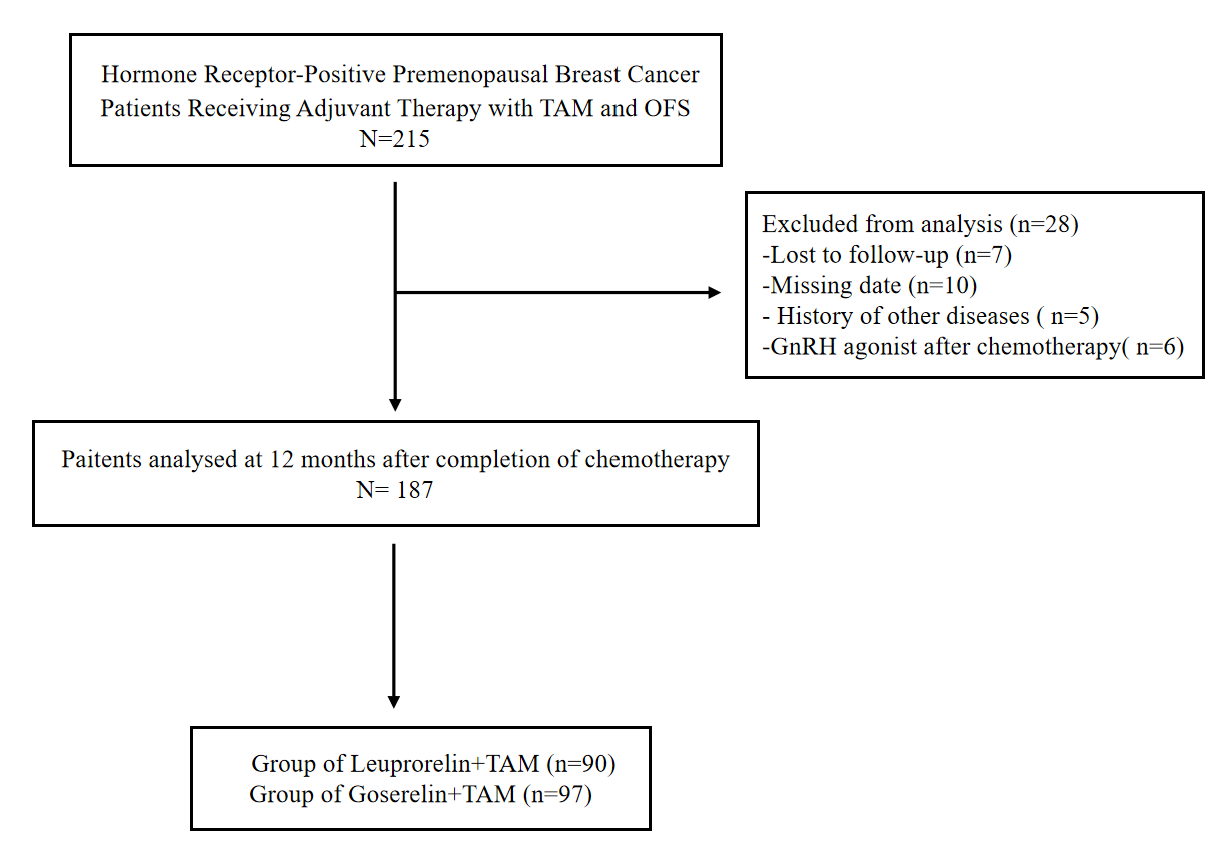
During the study period, 215 young cancer patients received adjuvant therapy with tamoxifen combined with GnRH agonists during chemotherapy. Among these, patients were excluded based on loss to follow-up (n=7), missing data (n=10), history of other diseases (n=5), or GnRH agonist use after chemotherapy (n=6). Ultimately, 187 females were included in the analysis. The patient selection flowchart is shown in Figure 1.
Flow chart for inclusion and exclusion of study subjects.
Source: Prepared by the authors of this study.
Based on the type of GnRH agonist administered, patients were classified into either the leuprolide group (n=90) or the goserelin group (n=97). As shown in Table 1, baseline demographic and clinical characteristics were well balanced between the two groups, with no statistically significant differences. Specifically, age, marital status, parity, body mass index, and menstrual status were comparable at baseline. Furthermore, cancer-related features—such as disease stage, estrogen receptor (ER) status, progesterone receptor (PR) status, Ki-67 expression level, and chemotherapy regimens—also showed similar distributions between the groups, confirming homogeneity in baseline prognostic factors.
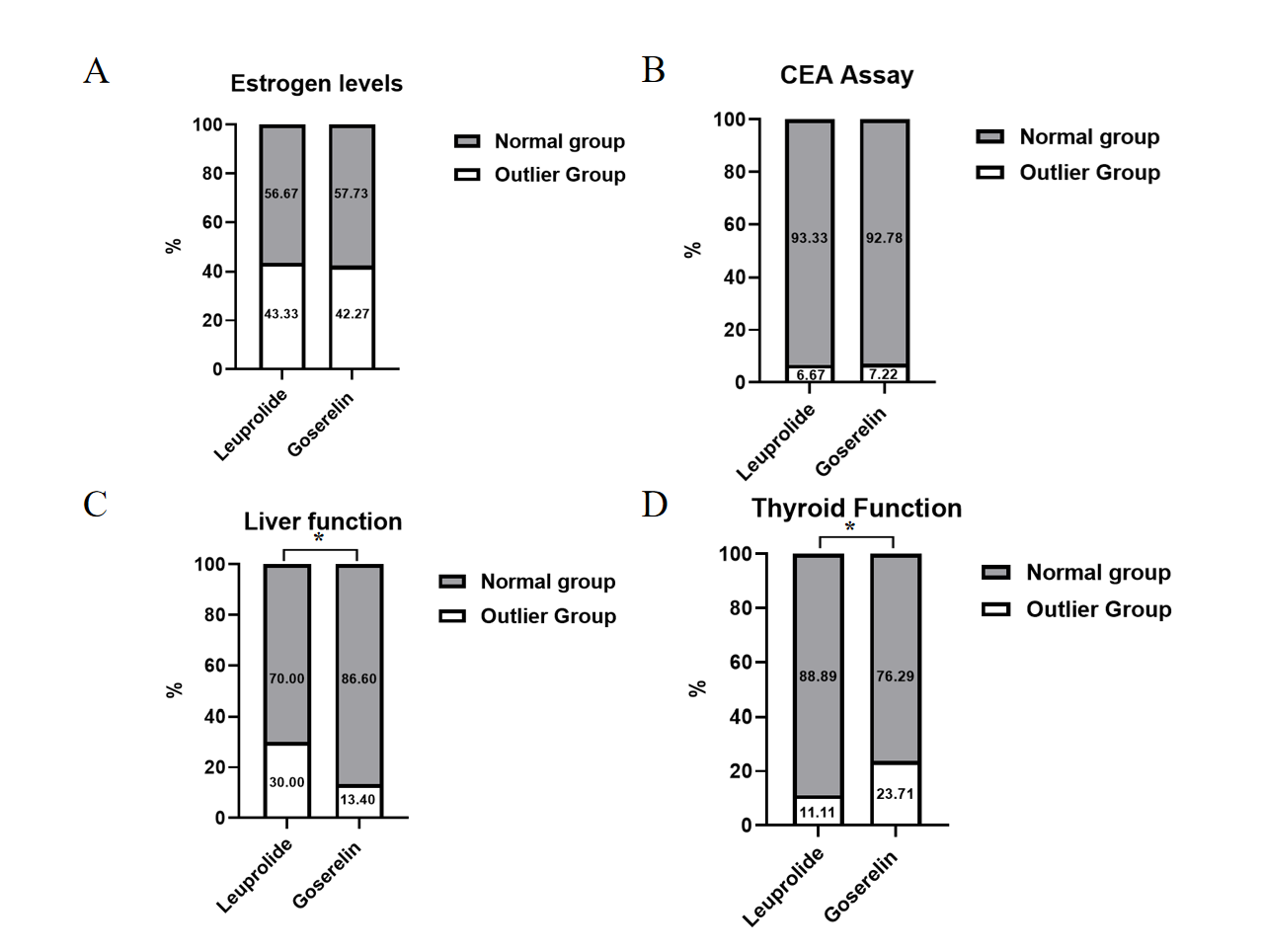
Biochemical outcome data of the study participants are summarized in Table 2, Table 3 and Figure 2. The proportion of patients achieving adequate ovarian suppression (estradiol ≤30 pg/mL) at six months was 88.89% (80/90) in the leuprolide group and 92.78% (90/97) in the goserelin group, with no significant difference between the two groups (RD = −3.89%, 95% CI: −12.18% to 4.40%; p = 0.354). Secondary hormone outcomes, including changes from baseline to 6 months in testosterone, LH, FSH, and prolactin levels, were also compared between the two groups.
Statistical chart of biochemical indicators for research subjects.
Source: Prepared by the authors of this study.
Multivariable logistic regression adjusting for age, body mass index, prior chemotherapy, surgery type, and taxane type confirmed that treatment group was not significantly associated with estrogen suppression (aOR = 0.98; 95% CI: 0.59 to 1.63; p = 0.939), with no significant covariates in the model (all p > 0.05; Table 3).
For safety outcomes, the proportion of patients with liver function abnormalities was significantly higher in the leuprolide group than in the goserelin group (30.00% vs. 13.40%; RD = 16.60%, 95% CI: 4.96% to 28.24%; p = 0.012). In contrast, the proportion of patients with normal thyroid function was significantly higher in the leuprolide group (88.89% vs. 76.29%; RD = 12.60%, 95% CI: 1.94% to 23.26%; p = 0.018).
Discussion
This study provides a head-to-head comparison of goserelin and leuprolide in the postoperative adjuvant treatment of premenopausal breast cancer patients, an area with limited real-world evidence. The results demonstrate that the two GnRH agonists yield comparable short-term biochemical efficacy when combined with tamoxifen, achieving similar rates of estrogen suppression to the postmenopausal range at 6 months. This finding aligns with the therapeutic goal of adjuvant endocrine therapy-namely, suppressing estrogen-driven tumor progression-and suggests that both agents effectively modulate the hormone microenvironment.
Notably, although the overall efficacy profiles were similar, distinct organ-specific safety differences were observed. Leuprolide was associated with a higher risk of hepatic impairment, whereas goserelin showed a more pronounced impact on thyroid function. These safety signals warrant careful consideration in clinical decision-making and may guide the choice of GnRH agonist based on individual patient risk factors.
The observed differences in organ-specific safety profiles may be related to the distinct molecular structures of the two GnRH agonists. Goserelin and leuprolide are synthetic decapeptide analogues of GnRH with different amino acid substitutions at positions 6 and 10, which may influence receptor binding affinity, drug stability, and metabolism [2,11,12,13]. Pharmacologically, both drugs act by downregulating GnRH receptors and suppressing gonadotropin secretion; however, subtle differences in receptor-binding kinetics and signal transduction pathways may contribute to variations in therapeutic response [14,15]. Pharmacokinetically, differences in absorption, bioavailability, and metabolism may also affect their safety and tolerability profiles [16,17]. Nevertheless, the current data are insufficient to establish causality, and the proposed mechanistic explanations require further validation. Moreover, the observed differences may be influenced by confounding factors such as baseline metabolic status, concomitant medications, or chemotherapy-related toxicities, which should be carefully considered when interpreting the findings. Further studies are needed to fully elucidate the structural and functional determinants of these differences and to optimize treatment outcomes for patients with premenopausal breast cancer. From a clinical perspective, these findings suggest that the choice between leuprolide and goserelin may be informed by patient-specific baseline characteristics. For patients with pre-existing liver dysfunction or elevated baseline liver enzymes, goserelin may be preferred to mitigate the risk of hepatic injury; conversely, for patients with a history of thyroid disorders or abnormal TSH levels, leuprolide may represent a more appropriate option to avoid potential thyroid dysfunction. Additionally, these results highlight the importance of targeted monitoring: routine liver function tests for patients receiving leuprolide and regular thyroid function assessments for those receiving goserelin. Naturally, these recommendations are preliminary and require validation through larger-scale, multicenter prospective studies.
This study demonstrates that adjuvant therapy combining leuprolide with tamoxifen and goserelin with tamoxifen yields comparable short-term biochemical efficacy in premenopausal breast cancer patients, as evidenced by similar rates of estrogen suppression to the postmenopausal range (≤30 pg/mL) at 6 months between the two treatment groups. This finding aligns with the therapeutic goal of adjuvant endocrine therapy—namely, suppressing estrogen-driven tumor progression—and suggests that both GnRH agonists, when combined with tamoxifen, effectively modulate the hormone microenvironment.
The Suppression of Ovarian Function Trial (SOFT) and the Tamoxifen and Exemestane Trial (TEXT) have established that ovarian function suppression provides sustained disease-free survival (DFS) benefits in premenopausal breast cancer patients [18,19]. The 12-year follow-up of Suppression of Ovarian Function Trial confirmed a persistent disease free survival improvement with the addition of ovarian function suppression [18], and the long-term follow-up of the combined Suppression of Ovarian Function Trial-Tamoxifen and Exemestane Trial analysis demonstrated sustained reductions in recurrence risk [19]. While our study was not designed to assess these long-term oncologic outcomes, the 6-month biochemical endpoint we employed—estradiol suppression to ≤30 pg/mL—is the same pharmacodynamic threshold underlying the ovarian function suppression achieved in these landmark trials. The comparable estradiol suppression rates observed between goserelin and leuprolide suggest that both GnRH agonists achieve the biochemical prerequisite for the long-term clinical benefits demonstrated in Suppression of Ovarian Function Trial and Tamoxifen and Exemestane Trial. However, it is important to acknowledge that this surrogate endpoint does not necessarily correlate directly with long-term oncologic benefit, such as disease free survival or overall survival. Our findings should therefore be interpreted as evidence of short-term biochemical efficacy and safety, and longer-term studies are needed to determine whether these effects translate into meaningful clinical outcomes.
From a clinical perspective, these findings suggest that the choice between leuprolide and goserelin may be informed by patient-specific baseline characteristics. For patients with pre-existing liver dysfunction or elevated baseline liver enzymes, goserelin may be preferred to mitigate the risk of hepatic injury; conversely, for patients with a history of thyroid disorders or abnormal TSH levels, leuprolide may represent a more appropriate option to avoid potential thyroid dysfunction. Additionally, these results highlight the importance of targeted monitoring: routine liver function tests for patients receiving leuprolide and regular thyroid function assessments for those receiving goserelin. Naturally, these recommendations are preliminary and require validation through larger-scale, multicenter prospective studies.
The strength of this study lies in its head-to-head comparison of goserelin and leuprolide in the postoperative adjuvant treatment of premenopausal breast cancer patients, an area with limited real-world evidence. All patients who met the eligibility criteria during the study period were consecutively included, which helped minimize selection bias. Comprehensive data on a wide range of clinical and pathological indicators were collected to assess both efficacy and adverse reactions, enhancing the robustness of our findings. Furthermore, the baseline characteristics between the two treatment groups were well balanced, and we performed multivariable regression analyses to adjust for potential confounders, which strengthens the validity of our comparative assessments
Several limitations of this study should be acknowledged. The retrospective, non-randomized design may have introduced confounding by indication, as treatment selection (including the choice of GnRH agonist and taxane type) was based on physician judgment rather than randomization. Although we adjusted for key confounders using multivariable logistic regression, we did not employ propensity score matching due to the limited sample size, and residual confounding from unmeasured factors cannot be fully excluded. Additionally, the single-center design may limit the generalizability of our findings. Importantly, while the 6-month follow-up was sufficient for assessing short-term biochemical efficacy and safety, it is inadequate to evaluate the persistence of organ-specific toxicity or its impact on long-term oncologic outcomes such as overall survival or quality of life. Therefore, our findings should be interpreted as exploratory, and future prospective studies with extended follow-up are warranted to confirm these observations.
Despite these limitations, the current results provide valuable real-world evidence to guide clinical practice. The comparable efficacy and differential safety profiles observed between the two GnRH agonists suggest that treatment decisions may be individualized based on considerations such as healthcare costs, drug availability, institutional practice, dosage form, and physician preference, while weighing the potential risks of liver toxicity with leuprolide and thyroid dysfunction with goserelin.
Conclusions
In summary, goserelin and leuprolide show comparable efficacy in adjuvant therapy for premenopausal breast cancer but differ distinctly in their safety profiles. These findings support the individualized selection of a GnRH agonist based on a patient’s specific risk profile and comorbidities. Further prospective studies with longer follow-up are warranted to validate these observations and to clarify the underlying mechanisms of the differential adverse effects.