
Estudios originales
← vista completaPublicado el 23 de septiembre de 2026 | http://doi.org/10.5867/medwave.2026.08.3234

Prevalencia de síntomas post-COVID, agrupamiento sintomático e impacto funcional: Estudio transversal de base poblacional en dos ciudades chilenas, 2024
Post-COVID symptoms prevalence, latent class pattern, and functional impact: A population-based cross-sectional study in two Chilean cities, 2024
Abstract
Introduction Post-COVID-19 condition affects approximately 6% of individuals globally. Most evidence is based on hospitalized patients and is from countries with relatively low vaccination coverage. This study estimates the prevalence of symptoms compatible with post-COVID-19 and explores symptom patterns in a population-based sample from Chile, a country with high vaccination coverage. Moreover, it examines their associations with daily activities and demographic, social, and clinical factors.
Methods A cross-sectional study was conducted in May 2024 in two Chilean Cities, involving 654 participants (88.5% response rate) aged ≥ seven years, from randomly selected households. Ten post-COVID-19 symptoms that persisted for ≥ three months were collected. Latent class analysis identified symptom patterns.
Results Among 277 participants with a confirmed COVID-19 diagnosis, 114 reported at least one symptom lasting ≥ 3 months. Population-weighted prevalence of at least one post-COVID-19 symptom was 17.4% in the general population and 40.7% among individuals with prior COVID-19. Among those with post-COVID-19 symptoms, 40.1% reported a reduction in daily activities. Three classes were explored: class 1 (38.4%) characterized by fatigue, ageusia/anosmia, and muscular/joint pain; class 2 (40.7%) with predominant cardiorespiratory symptoms; and class 3 (20.9%) with multisystemic symptoms. Class three was associated with a higher frequency of comorbidities (particularly diabetes), hospitalization, multiple COVID-19 episodes, and Aboriginal affiliation. Classes 2 and 3 were independently associated with younger age and diabetes, class 2 was additionally associated with lower educational attainment and lower BMI, while class 3 was additionally associated with Aboriginal affiliation.
Conclusions This population-based study reveals a substantial burden of at least one post-COVID-19 symptom, with distinct symptom classes highlighting the need for tailored interventions. These findings underscore the importance of targeted public health policies and personalized clinical approaches, particularly for severe symptom classes that impact quality of life and contribute critical data from Latin America to the global understanding of post-COVID-19 condition.
Main messages
- Understanding the population-level burden of post-COVID-19 symptoms is critical for public health response
- Prevalence of post-COVID-19 symptoms reached 40.7% in those with a diagnosis of COVID-19 and 17.4% in the whole population.
- The three explored phenotypes require distinct clinical protocols, enabling prioritization of high-risk subgroups for intensive monitoring and comprehensive care.
- The main limitation is the cross-sectional design, which precludes causal inference and assessment of symptom progression over time.
- The most severe class (the multisystemic phenotype) was independently associated with younger age, diabetes, and Aboriginal affiliation.
Introduction
The post-COVID-19 condition [1,2], also known as long COVID, is characterized by a set of symptoms that persist after the acute phase of SARS-CoV-2 infection, typically for 4 to 12 weeks or longer. Despite its widespread recognition, the condition lacks a standardized definition [1,3], likely because its symptoms are heterogeneous and multisystemic, affecting the respiratory, cardiovascular, neurological, gastrointestinal, and musculoskeletal systems. Among these varied and heterogeneous manifestations, general symptoms such as fatigue are common, with fatigue being the most frequently reported [4].
The World Health Organization (WHO) estimates that approximately 6.2% of individuals who survive acute COVID-19 infection develop post-COVID-19 condition [5,6]. Several factors have been described as influencing the type and severity of post-COVID-19 symptoms, including gender, age, severity of acute infection, pre-existing comorbidities, socioeconomic status, ethnicity, vaccination status, and the SARS-CoV-2 variant responsible for the infection [7,8,9,10]. These factors contribute to the variability in clinical presentation and underscore the need for tailored approaches to diagnosis and treatment.
Due to the heterogeneity of symptoms and affected systems, researchers have attempted to identify symptom patterns by using various clustering methodologies. Among the methods used are exploratory factor analysis [11], agglomerative hierarchical clustering (Ward’s method) [12,13,14,15,16], non-negative factorization matrices [17], latent class analysis (LCA) [18,19], and partitioning around medoids [20] (k-medoids), including multi-methods [15,16].
Common classes include respiratory symptoms, neurological/mental/psychiatric symptoms, cardiovascular/cardiac/circulatory symptoms, musculoskeletal/nervous symptoms, digestive/diarrhea symptoms, and other isolated symptoms such as fatigue, pain, and minor symptoms. At the same time, studies have reported that respiratory symptoms are more frequent in hospitalized patients and those with severe acute infections [14]. Likewise, neuropsychiatric symptoms were more frequent in young people, in women, and in outpatients [20].
The available literature on post-COVID-19 conditions consists primarily of studies conducted in countries outside Latin America, with most research focusing on hospitalized patients, self-reported individuals with COVID-19, or utilizing data from hospitals or healthcare centers. Nevertheless, there remains limited evidence from population-based studies that include individuals who have not engaged with the health system, a gap that is particularly relevant in countries with high vaccine coverage and persistent health inequalities, like Chile [21,22]. This study aims to report a) the prevalence of symptoms compatible with the post-COVID-19 condition in a population-based sample from two Chilean cities, b) explore symptom classes, and c) examine their relationship with the reduction of daily activities and demographic, social, and clinical factors.
Methods
Study design and setting
This cross-sectional study presents a secondary analysis of a population-based COVID-19 seroprevalence survey conducted in La Serena/Coquimbo and Talca, Chile, in May 2024 [22].
Participants
All participants from a prior data collection wave [23] were re-invited. Non-responders were replaced using two-stage random sampling (census block selection, then systematic household selection within blocks). Non-participating households were systematically replaced either in the same block or, if necessary, through random block replacement. All household members aged ≥ seven years were eligible to participate. The same recruitment methodology was employed in previous study round [21,24].
Study size
The current study is a secondary analysis of a sample originally powered for seroprevalence. The sample size was calculated based on the 97% seroprevalence [23]. Assuming a margin of error of 3%, 95% confidence level, and a design effect of 2.0 to account for the two-stage sampling. The minimum required sample size was 249 participants per city (498 total). Sample size calculation was performed using the OpenEpi software.
Variables
Dependent Variables: Participants self-reported COVID diagnosis (polymerase chain reaction, antigen, or clinical diagnosis). Ten post-COVID-19 symptoms persisting for > three months after infection were assessed using Household Pulse Survey questions developed by the National Center for Health Statistics and the Census Bureau in the United States of America [25]. Items were translated directly into Spanish and culturally adapted to local language use where necessary. Each symptom was rated as present or absent (yes/no): cognitive impairment, memory impairment, vertigo or dizziness, anosmia or ageusia/altered taste, dyspnea, chest pain, palpitations, fatigue, exercise intolerance, and musculoskeletal pain. These items were selected for their brevity and prior use in large-scale population surveillance, facilitating comparability with international post-COVID-19 condition estimates; however, they were not subjected to formal cross-cultural adaptation or psychometric validation in the Chilean population. Reduction in daily activities was an additional outcome variable.
Independent variables: sex (male/female/other/prefer not to answer), age (< 30, 30 to 59, ≥ 60), aboriginal affiliation (yes/no), education (participants ≥18: high school education or less/technical/professional-postgraduate), health insurance (public/private/armed forces), Body Mass Index (BMI) (self-reported: underweight/normal/overweight/obese), smoking (yes/no), comorbidities (neoplastic disease/heart disease/chronic kidney disease/hypertension/obesity/autoimmune disease/diabetes), vaccination (none/first dose and booster/bivalent or omicron), COVID-19 episodes (one vs ≥ two), and due to COVID-19 hospitalization (yes/no).
Data sources and measurements
Trained undergraduate health science students conducted standardized 15-to-20-minute home interviews using questionnaires. Interviewers were trained in consistent data collection and entered data in real time into REDCap using tablets. Data collected included: demographics, COVID-19 history, COVID–19 symptoms, vaccine history, post-COVID-19 symptoms, and risk factors. Vaccination status was verified using two approaches: (1) vaccine card or participant accessing their records through the national immunization registry portal or presenting vaccination cards; (2) when this was not possible, participants authorized the research team to obtain records directly from the national immunization program. The data manager and principal investigator performed daily quality checks; when necessary, participants were recontacted to resolve inconsistencies or data-entry errors.
Statistics
Prevalence rates were calculated based on the population expansion of the sample. Expansion factors were calculated considering a two-stage, structured probabilistic sampling design: 1) conditional household selection probability within census district, 2) individual selection probability (≥7 years) assuming equivalent probabilities within the household, 3) differential nonresponse adjustment based on the number of actual participants in each household, 4) calibration based on 2024 population projections estimated by the National Institute of Statistics.
The expansion factors were derived from the sampling design used for the seroprevalence and were not recalculated for nonresponse specific to the symptom questionnaire. Since all participants answered the symptom questionnaire, no additional non-response adjustment was necessary. Descriptive statistics were computed for each symptom, including proportions and standard errors, to summarize the prevalence of post-COVID-19 symptoms. All symptom variables were dichotomous (yes/no). Latent class analysis (LCA) was utilized to identify unobserved subgroups based on the co-occurrence of post-COVID-19 symptoms. Latent class analysis models the conditional independence structure within each latent class, enabling it to identify symptom types where specific symptom classes co-occur. Furthermore, latent class analysis classes directly correspond to interpretable patient phenotypes with clear probabilistic symptom profiles that will be further explored in the paper. The latent class analysis model was specified without covariates, assuming conditional independence between symptoms within each latent class. Several strategies were explored to determine the number of classes, including the elbow method and the Bayesian Information Criterion (BIC). While the Bayesian Information Criterion continued to improve beyond three classes, the final 3-class solution was selected based on interpretability and clinical relevance [26] rather than statistical fit alone. Finally, we combined the elbow method with a normative decision, acknowledging that identified groups are meaningful, interpretable, and useful for policy or clinical applications. Conditional response probabilities for each symptom across latent classes were estimated, and individuals were assigned to the most likely latent class based on posterior probabilities. Sociodemographic, daily activities reductions, and clinical characteristics were then summarized for each class to provide comparative profile. To examine the association between sociodemographic and clinical characteristics and membership in the latent post-COVID-19 symptom classes, survey-weighted multinomial logistic regression models were estimated using the complex sampling design of the study population. Class membership was specified as the dependent variable, with Class 1 serving as the reference category. Exponentiated coefficients are presented as relative rate ratios (RRRs), representing the relative likelihood of belonging to Class 2 or Class 3 compared with Class 1. The fully adjusted model included all variables associated with class membership at p<0.10 in the bivariate comparison: aboriginal affiliation, educational attainment, number of previous COVID-19 episodes, smoking status, history of hospitalization due to COVID-19, diabetes, and body mass index (BMI). Sex and age were retained in the model despite not reaching statistical significance in the bivariate analysis, given their role as potential confounders. Survey weights were incorporated in all analyses to account for the sampling design and produce population-representative estimates. To ensure representativeness, analyses applied survey weights and were conducted in RStudio (version 2024.12.1+563) using R (version 4.5.0) or in STATA/IC 15 (StataCorp LLC).
Ethics approval
All procedures performed in studies involving human participants were in accordance with the ethical standards of the institutional and/or national research committee (1) Scientific ethical committee from the Faculty of Medicine, Universidad Católica del Norte, Resolution number 63/2023, dated October 16th, 2023. (2) Scientific ethical committee from the Faculty of Medicine, Universidad del Desarrollo, dated December 13th, 2023, and 3) Scientific ethical committee from Universidad de Talca, Folio 30-2023-E, dated April 17th, 2024. Additionally, it was approved by the Institutional Committee of Biosecurity of Universidad Católica del Norte 07/2023 dated October 2023, Universidad del Desarrollo, CIB-FORM-01B, dated 14 November 2023, and Universidad de Talca 20-CBS-2023 dated November 9th, 2023) and with the 1964 Helsinki declaration and its later amendments or comparable ethical standards. Informed consent was obtained from all subjects involved in the study, including assent from minors (7 to 17 years).
Results
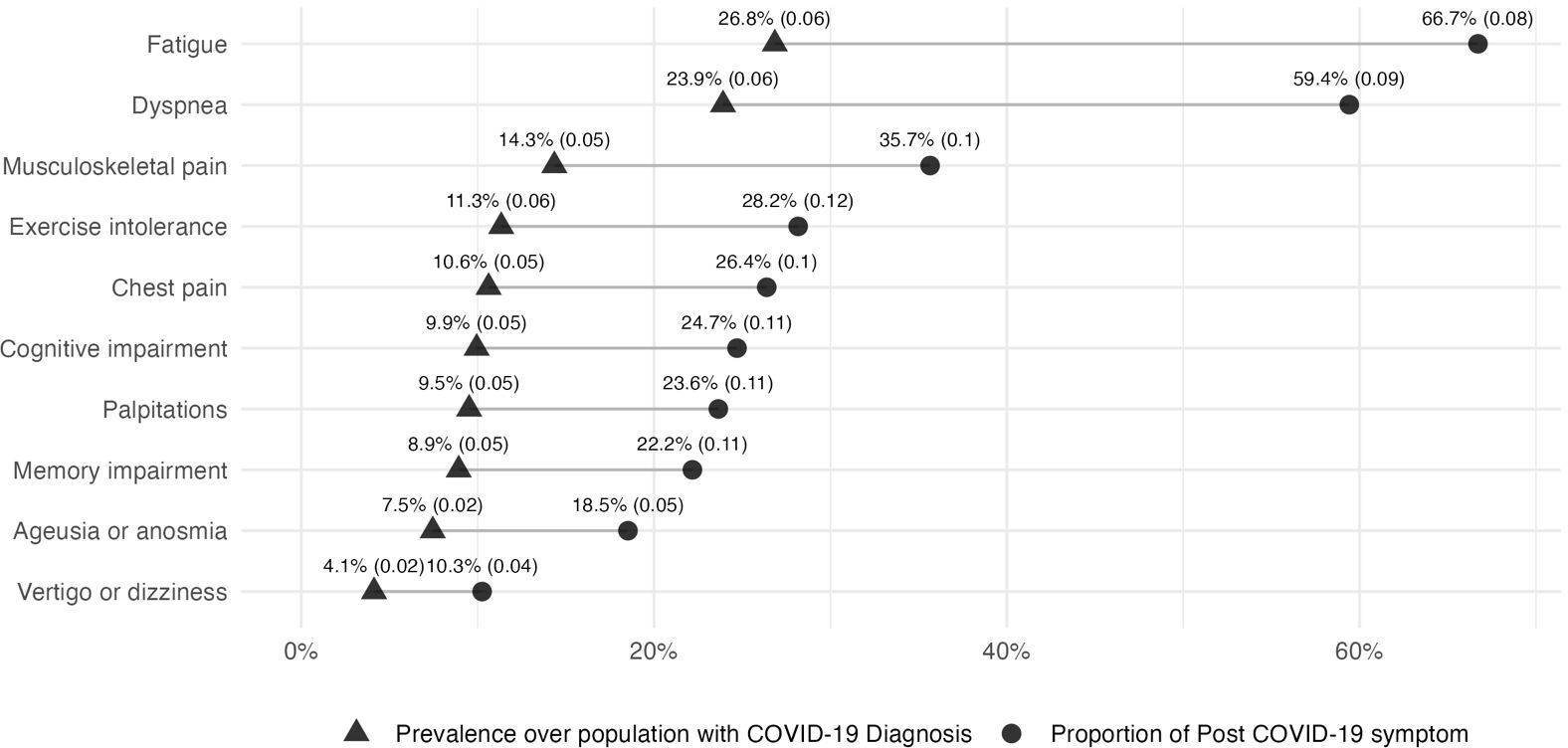
A total of 654 participants were recruited in May 2024 (response rate 88.5%): 318 from La Serena-Coquimbo and 336 from Talca (Supplementary data. online supplementary figure 4). Across both cities, 277 reported prior COVID-19 infections confirmed by Polymerase Chain Reaction, antigen test, or medical diagnosis. Among them, 117 reported at least one post-COVID-19 symptom, with a mean age of 49.9 years (range: 7 – 95). Three women reported menstrual changes as their sole symptoms (these cases were excluded to avoid gender-specific bias). The final analytic sample comprises 114 individuals(Figure 1).
Population prevalence of post-COVID-19 symptoms among individuals with prior COVID-19 diagnosis and symptoms proportion among those reporting persistent symptoms lasting ≥3 months, Chile, May 2024.
Source: Prepared by the authors of this study.
In the expanded sample (n = 722 430), 52.0% were female. The population-based prevalence of at least one post-COVID-19 symptom was 17.4%, and 40.7% among those with prior COVID-19. Figure 2 presents the prevalence of post-COVID-19 condition symptoms as percentages among individuals with prior COVID-19, and those who have experienced at least one symptom lasting for at least three months. Fatigue was the most common (66.7%), followed by dyspnea (59.4%), musculoskeletal pain (35.7%), and exercise intolerance (28.2%). Chest pain (26.4%) and palpitations (23.6%) were also frequent. Neuro-sensorial symptoms included cognitive impairment (24.7%), memory issues (22.2%), olfactory or taste alterations (18.5%), and dizziness (10.3%).
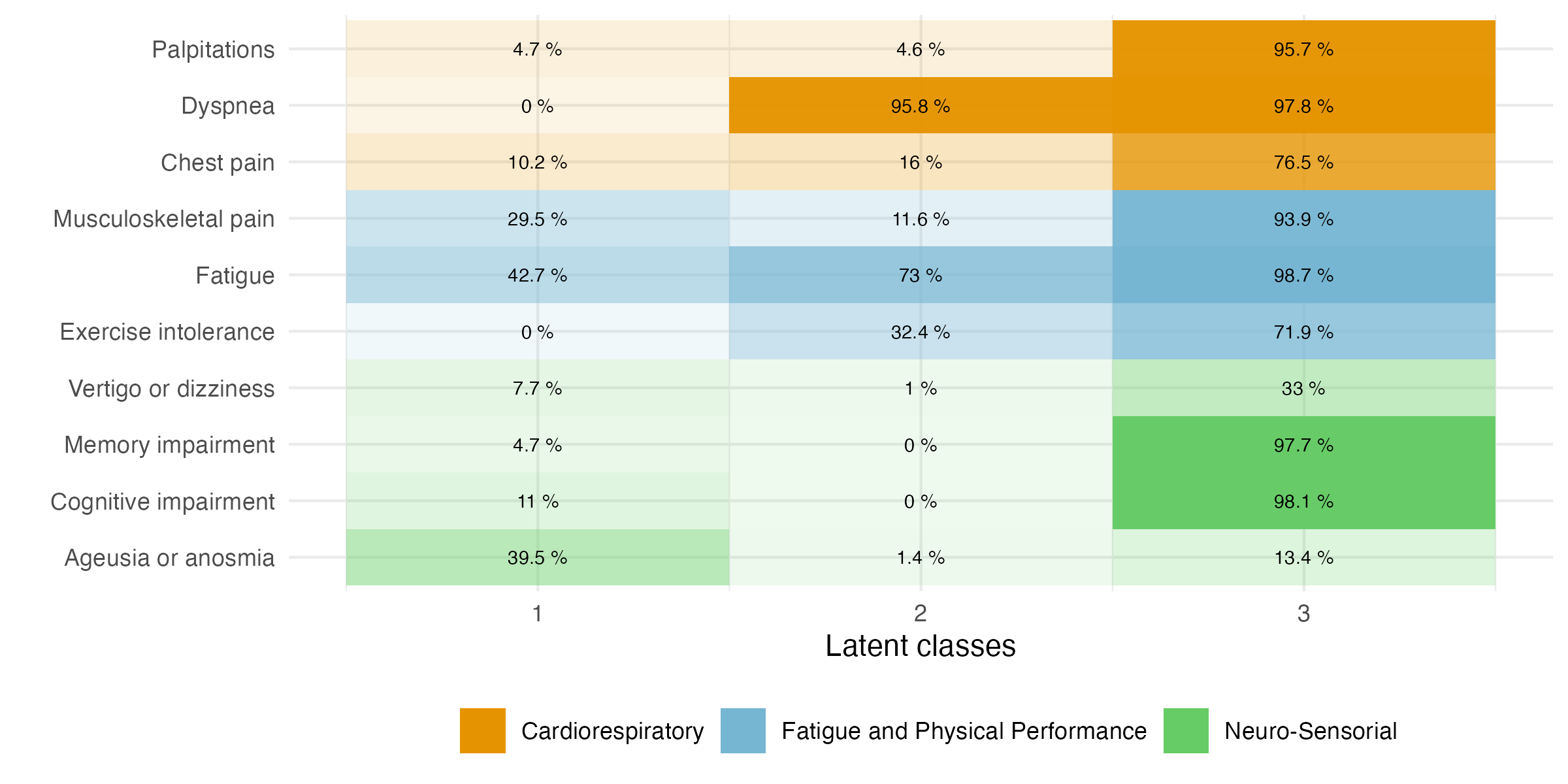
Latent class analysis of post-COVID-19 symptoms: Probability of symptoms by class, Chile, 2024.
Source: Prepared by the authors of this study.
Regarding symptoms interfering with daily activities, 40.1% reported limitations. Individuals without daily activity reduction reported the fewest symptoms (median two), concentrated between one and three (mean: 3.04). Those with a slight reduction in daily activity had a median of three, interquartile range (IQR) two to three (mean: 3.2). In contrast, individuals with a major reduction also had a median of three symptoms but a higher mean (4.8) and wider IQR (three to eight), indicating greater heterogeneity and symptom burden (Supplementary information. online supplementary figure 5).
Three main classes emerge: Class 1 grouped symptoms related to fatigue and physical performance, including chest pain, fatigue, dyspnea, and exercise intolerance. Class 2 includes symptoms such as palpitations, memory and cognitive impairment, musculoskeletal pain, and vertigo or dizziness, reflecting a combination of cardiorespiratory and neurological manifestations. Class 3 comprised taste alteration and ageusia, consistent with neuro-sensorial alterations.
Following a normative decision, the latent class analysis seems to have converged on a three-class solution after multiple iterations with different starting values were run to ensure model stability (Supplementary Material). The latent class analysis identified three latent classes: Class 1 (38.4%, n = 48,230); Class 2 (40.7%, n = 51,115); and Class 3 (20.8%, n = 26,177) (Table 1 and Figure 2). Conditional item response probabilities reveal three distinct post-COVID-19 condition symptom structures. Class 1 exhibited high probabilities of fatigue (42.7%), ageusia or anosmia (39.5%), and musculoskeletal pain (29.5%), but relatively low probabilities of cognitive symptoms, suggesting a predominantly physical symptoms profile. Class 2 represents a phenotype with high probabilities across various domains, such as dyspnea (95.8%), fatigue (73%), and exercise intolerance (32.4%), but with almost no neurological manifestations. Finally, Class 3 includes a group with very high probabilities across all symptoms (mostly over 70%).
Table 1 presents the distribution of the study variables across latent class analysis classes. Class 1 and 2 had the highest proportion with High school or less education. Class 3 had the highest proportion of participants with Aboriginal affiliation, technician education, comorbidity, diabetes, multiple COVID-19 episodes, and hospitalization. It also included a higher proportion of men and tobacco users, although these differences were not statistically significant. All symptoms varied significantly across classes, with Class 3 showing the highest prevalence of symptoms.
Multinomial logistic regression analysis used class 1 as the reference category. Age was retained in the model as a potential confounder despite not reaching significance in the bivariate analysis (Table 2). In the adjusted model, younger participants were more likely to belong to class 2 (RRR = 0.95; 95% CI: 0.90 to 0.99; p = 0.04) and 3 (RRR = 0.92; 95% CI: 0.86 to 0.99; p = 0.03), relative to class 1. Diabetes was independently associated with both class 2 (RRR = 35.25; 95% CI: 3.57 to 348.0; p = 0.00) and class 3 (RRR = 11.75; 95% CI: 1.44 to 95.84; p = 0.02). Class 2 was additionally associated with lower body mass index (RRR = 0.83; 95% CI: 0.75 to 0.93; p = 0.00) and with educational attainment: compared to participants with high school education or less (reference), having higher technical education was associated with substantially lower relative risk of class 2 membership (RRR = 0.08; 95% CI: 0.01 to 0.42; p = 0.00), while professional/postgraduate education showed no significant association (RRR = 1.34; 95% CI: 0.37 to 4.80; p = 0.65). Class 3 was additionally associated with Aboriginal affiliation (RRR = 10.98; 95% CI: 1.74 to 69.44; p=0.01). No significant associations were found for sex, number of previous COVID-19 episodes, smoking status, or history of hospitalization due to COVID-19 in either class.
Discussion
Among individuals with prior COVID–19 infection, 40% experienced at least one symptom persisting for three months, underscoring post-COVID-19 as a significant public health concern. Latent class analysis identifies three phenotypes. The most severe class, the multisystemic phenotype, had high prevalence of comorbidities, hospitalization due to COVID-19, multiple episodes of COVID-19, and sociodemographic variables. After adjustment, multinomial logistic regression confirmed younger age and diabetes as independent correlates of both symptom classes (2 and 3), with class 2 additionally associated with lower educational attainment and lower BMI, and class 3 with Aboriginal affiliation.
The prevalence of symptoms compatible with post-COVID-19 condition observed in our study was consistent with that reported in an independent systematic review and meta-analysis, which showed a prevalence of 45% regardless of hospitalization status [27].
The identification of distinct latent classes reflects the heterogeneous clinical presentation of post-COVID-19 condition, in which symptoms are grouped according to severity or pathological mechanisms rather than affected organs or systems involved [15,18]. Our findings are consistent with existing literature. The identified phenotypes align with cardiorespiratory, systemic/inflammatory, and neurological classes described in a recent meta-analysis [28], and with a two-year follow-up study of severe COVID-19 cases in Latin America [29]. Class 1 is characterized by low symptom burden, suggesting a milder clinical phenotype. However, its high prevalence, combined with the presence of sensory and musculoskeletal manifestations, may significantly impair quality of life and limit the resumption of routine activities.
These symptoms are frequently associated with low-grade inflammation, endothelial dysfunction, and mitochondrial impairment, leading to fatigue and exercise intolerance [30]. Phenotypes dominated by somatic or sensory symptoms are more common among younger individuals, women, and those without significant comorbidities [31,32]. This aligns with findings by Ito et al. [33] [33] who identified a class characterized by taste and smell disorders, primarily comprising young women with mild acute symptoms.
Cardiorespiratory symptoms, predominantly respiratory in Class 2, are commonly reported [32]. This arises from persistent inflammation, cardiac thrombi, endothelial dysfunction, autoimmunity, or viral persistence [30]. Such symptoms are also associated with pre-existing chronic respiratory disease [31,32,33,34]. Although this study found no statistical inter-class differences in chronic respiratory comorbidities, a higher proportion of affected individuals was observed in Class 2 -characterized by frequency of dyspnea- compared to the other two classes.
Class 3, characterized by the highest symptom burden with predominantly neurological and cardiorespiratory manifestations, exhibits multisystemic involvement associated with significant functional impairment. This is probably attributable to neuroinflammation and autonomic dysfunction [30], consistent with findings reported by Arango-Ibañez et al. [29]. This class showed statistical differences with a higher proportion of individuals with Aboriginal affiliation and diabetes. Ethnic minority status has been identified as a risk factor for post-COVID-19 condition, with increased likelihood of cardiopulmonary symptoms as observed in our Class 3 [35].
Hospitalized COVID-19 survivors demonstrated higher post-COVID-19 risk than non-hospitalized patients [36]. Hospitalization severity further increases post-COVID-19 risk [37], although this association may be confounded with Post-Intensive Care Unit Syndrome [38]. In contrast, hospitalization was significantly associated with class membership in the bivariate analysis, but lost significance in the multivariate model once other severity-related variables (e.g., diabetes, number of COVID-19 episodes) were included, suggesting that its apparent effect was largely confounded by these factors rather than reflecting an independent association.
Class 3 had a higher proportion of individuals with two or more COVID-19 infections compared to other classes. This aligns with disease pathophysiology, as damage increases with repeated acute infection. Babalola et al., in a retrospective study of 2,511 essential workers, demonstrated that repeated SARS-CoV-2 infections, combined with a reduced viral clearance capacity, may promote viral persistence and contribute to post-COVID-19 syndrome development [39]. A similar pattern emerged in bivariate analysis, but the association did not persist after multivariable adjustment, indicating that repeated infections are not an independent predictor of symptom phenotype.
While Classes 1 and 2 showed a higher proportion of individuals with high school or less education, Class 3 had the lowest proportion with professional education. However, no existing studies explicitly explain this educational disparity within post-COVID-19 symptoms classes. Some evidence suggests reduced family income may contribute to persistent COVID-19 symptoms [40].
Comorbidities are associated with increased risk of post-COVID-19 symptoms. A meta-analysis of 34 studies showed that pre-existing conditions, including anxiety and/or depression, asthma, chronic obstructive pulmonary disease, diabetes, ischemic heart disease, and immunosuppression, significantly increased post-COVID-19 risk [41]. Similarly, Falsetti et al. showed that a higher Charlson Comorbidity Index score is associated with greater likelihood of developing post-COVID-19 [42]. Diabetes has been particularly associated with post-COVID-19 symptoms [43]. The underlying mechanisms may involve weakened immune response or proinflammatory state that, combined with virus-triggered inflammation, promote prolonged responses to SARS-CoV-2 [44,45]. In our study, diabetes was independently associated with classes 2 and 3, relative to class 1, on multivariable analysis. While one study suggests this association reflects higher diabetes prevalence in older population [33] we found no significant differences in diabetes prevalence across age groups.
Although no significant differences were found between classes, Class 3 (high cardiorespiratory and neurological symptom burden) showed higher male proportions, contrary to previous reports [18]. Women were more prevalent in the two most common classes with less severe symptoms, while the most severe class had the highest proportion of people with comorbidities. Psychological and psychosomatic factors critically influence long COVID symptoms persistence, potentially acting as triggers and highlighting the need for a multidisciplinary approach. These factors are predominantly associated with female sex, though this study did not specifically assess these pathologies; however, previous studies have established this link [46,47]. No age differences were observed; specifically, Class 3 did not contain higher elderly proportion. Other studies similarly found no association between symptom prevalence and older ages [29,48].
Vaccination showed no classes differences, consistent with similar study [49]. This may reflect our categorization approach (first dose/booster versus bivalent/Omicron) rather than vaccination status (yes/no). Categorizing vaccinated versus unvaccinated was impossible given the high national vaccination coverage (98,3%). Two systematic reviews indicate inconclusive evidence; however, studies suggest pre-infection vaccination may reduce post-COVID-19 risk [50,51].
Although smoking increases the post-COVID-19 symptoms [52], tobacco use showed no significant differences among classes; however, the prevalence of smokers in Class 3 was 2.5 and 3.5 times higher than in Class 2 and Class 1, respectively. A possible explanation is that smoking affects symptom severity through pathophysiological pathway rather than creating symptom patterns.
Excess weight is generally associated with post-COVID-19 symptoms. A recent systematic review and meta-analysis found obesity most strongly associated with smell disorder (OR = 1.16; 95% CI: 1.11 to 1.22) and taste disorder (OR = 1.22; 95% CI: 1.08 to 1.38) [53]. In our study, anosmia/ageusia was a defining feature of class 1, which may partly explain why lower, rather than higher, BMI was associated with class 2 membership. However, since BMI was self-reported, potential misclassification cannot be ruled out.
Post-COVID-19 symptoms occur in severity-based classes rather than by symptom number or system, requiring differentiated interventions. This research guides personalized therapeutic strategies. The healthcare system should develop targeted interventions for each class, with priority given to individuals reporting substantial quality of life impairment, independent of hospitalization status during acute COVID-19 infection. In Chile, Garantías Explicitas de Salud (Explicit Health Guarantees) cover post-COVID-19 diagnosis and treatment only for patients who were hospitalized during the acute infection [54]. Although only 15% of COVID-19-positive individuals overall were hospitalized, 60% of Class 3 patients were, yet the remaining 40%, despite similar severity, went without guaranteed care.
This is the first population-based investigation to assess post-COVID-19 condition symptoms in Chile and provide evidence from Latin America, a region frequently underrepresented in scientific literature. Symptoms class analysis enables the identification of patterns rather than simply counting. While deterministic methods are commonly used for their simplicity and transparency, LCA offers greater flexibility, adopting probabilistic framework to uncover latent patterns. This flexibility comes at a cost: class number is not fully data-determined, and larger future studies should assess phenotype reproducibility.
This study has limitations. Its cross-sectional design precludes causal inference and assessment of symptom progression. Recall bias is an inherent limitation, as symptoms, prior infections, and their timing were self-reported—often months to years after the acute episode—which may have led to underreporting or symptom misattribution and affected the accuracy of prevalence estimates. Symptoms lacked clinical validation and adjustment for previous history. Most participants neither required hospitalization nor experienced severe COVID-19. Focusing on survivors introduces survival bias. Older adults are likely underrepresented, given the high mortality in this group. Symptom severity was not directly measured, though daily activity reduction was used as a proxy. BMI was self-reported, which may have introduced misclassification bias. The exclusion of rural areas limits generalizability to Chile’s urban context. Longitudinal studies are needed to address these limitations. We acknowledge potential barriers to participation in this study among the most marginalized groups (homeless, undocumented migrants, institutionalized populations). Future studies should employ targeted outreach strategies to ensure full inclusion of historically excluded populations. As the sample was not originally designed for post-COVID-19 symptoms prevalence estimation or latent class analysis, precision and class stability may be limited; however, the achieved sample size supports exploratory analysis, and the 100% questionnaire response rate—using expansion factors from the seroprevalence study’s design—likely limits this impact. Data on time since infection, viral variant, reinfection history, mental health, and post-ICU syndrome were not systematically collected, potentially contributing to residual confounding in symptom heterogeneity; future studies should incorporate these factors for a more comprehensive understanding.
Conclusions
There is a substantial burden of post-COVID-19 conditions among individuals who experienced COVID-19. A three-class structure offers the clearest clinical interpretation among the models tested, though this classification should be treated as exploratory rather than definitive. These three symptom classes identified may guide clinical diagnosis and treatment. Class 1 (38.4%) includes individuals with fatigue, ageusia, and musculoskeletal pain (physical/inflammatory phenotype). Class 2 (40.7%) was characterized by predominantly dyspnea, cardiorespiratory symptoms, and fatigue. Class 3 (20%), though less prevalent, involves multisystemic phenotype symptoms and a high frequency of reduced activities of daily living. This more severe class was associated with diabetes and Aboriginal affiliation in the adjusted multivariable analysis. Care strategies should prioritize individuals whose daily activities are impaired, with attention to factors linked to the most severe symptom class. Regardless of other factors, diabetes emerged as a variable of interest across class 2 and class 3.