Revisión sistemática
← vista completaPublicado el 30 de julio de 2026 | http://doi.org/10.5867/medwave.2026.06.3217
Efectividad y seguridad de acetazolamida más diuréticos de asa en insuficiencia cardíaca aguda congestiva: Una revisión sistemática viva – Versión 2026 1.0
Effectiveness and safety of acetazolamide plus loop diuretics in acute congestive heart failure: A living systematic review - Version 2026 1.0
Abstract
Objective This living systematic review Version 1.0 aims to provide a timely, rigorous and continuously updated summary of the evidence on the use of acetazolamide plus loop diuretics in acute congestive heart failure compared to loop diuretics.
Methods We conducted a comprehensive search in CENTRAL, EMBASE, MEDLINE, and between database inception and September 2025. No language, publication date or status restrictions were applied. Two reviewers independently screened eligible studies, according to predefined selection criteria, and extracted data using a predesigned form. We performed meta-analyses using random-effects models and assessed overall certainty in evidence using the GRADE approach. The quality of the evidence was assessed using the Cochrane risk-of-bias tool. This review was registered in PROSPERO (CRD42024575267).
Results Of 732 records identified, five randomized trials were included, with a total of 1050 participants. The evidence is very uncertain about the effect of adding acetazolamide to loop diuretics in decongestion observed at 72 hours (risk ratio: 1.17, 95% confidence interval: 0.96 to 1.44). Low certainty evidence shows adding acetazolamide to loop diuretics may increase natriuresis at 24 hours (mean difference 38.43, 95% confidence interval: 19.42 to 57.43). No significant differences were found between groups in accumulative diuresis at 48 hours, all-cause mortality, readmission due to heart failure or worsening renal function.
Conclusions Evidence suggests that it is necessary to promote further investigations regarding the use of acetazolamide plus loop diuretics in acute congestive heart failure. More robust, standardized, long-term studies are needed, and conclusions may change as new data emerge.
Main messages
- The evidence is very uncertain about the effect of adding acetazolamide to loop diuretics in decongestion at 72 hours.
- Low-certainty evidence shows adding acetazolamide to loop diuretics may increase natriuresis at 24 hours.
- No significant differences were found between groups in accumulative diuresis at 48 hours, all-cause mortality, readmission due to heart failure or worsening renal function.
- More robust, standardized, long-term studies are needed.
Introduction
Heart failure is a highly prevalent and complex clinical syndrome, affecting 1 to 2% of the global population and up to 10% in patients over 70 years old, with a substantial and growing economic burden [1,2,3]. Despite therapeutic advances, heart failure continues to drive high mortality, related to acute heart failure, and more than one million hospital admissions annually [4].
Congestion in heart failure is defined as the presence of signs and/or symptoms resulting from elevated cardiac filling pressures, reflecting volume overload at the pulmonary and/or systemic level [5]. However, defining congestion (and decongestion) in clinical practice has been challenging. No clear consensus exists on the preferred assessment of congestion [6]. Plus, one of the cornerstones of treatment in acute congestive heart failure is the management of volume overload symptoms using diuretics [7].
Loop diuretics are currently the first-line therapy for congestion in heart failure, via diuresis and natriuresis [1,7,8]. However, a significant proportion of patients are discharged with persistent signs of volume overload even when administered at high doses, as demonstrated in the DOSE [9] and ADHERE trials [10]. Furthermore, the EVEREST trial [11] showed that residual congestion at discharge is associated with worse outcomes, including greater dyspnea, increased discharge weight and peripheral edema, and higher rates of the composite endpoint of mortality and rehospitalization for heart failure. Recently, the RELAX-AHF-2 analysis of 5900 patients with acute heart failure showed that residual congestion at day five was frequent, with 57% of patients presenting any signs and 18% having significant residual congestion [12].
These findings have driven the ongoing pursuit of more effective strategies to optimize volume management in heart failure. Several studies [9,11,13,14] have evaluated the sequential nephron blockade strategy, combining diuretics with different mechanisms of action, to overcome diuretic resistance, with generally acceptable safety profiles, without clarity as to which strategy is better.
The 2021 European Society of Cardiology (ESC) guidelines on heart failure recommend thiazide diuretics as second-line agents to manage congestion [7], however the 2023 European Society of Cardiology update [8] included the CLOROTIC [14] then the ADVOR trials [15], exploring the benefits of adding acetazolamide to loop diuretics therapy, to achieve decongestion.
Acetazolamide inhibits carbonic anhydrase in the renal proximal tubule, reducing sodium reabsorption by interfering with the sodium-hydrogen exchanger (NHE3). This action decreases bicarbonate and sodium reabsorption, promoting osmotic diuresis [6,16]. Accordingly, the addition of a proximal tubule-acting diuretic such as acetazolamide may enhance clinical outcomes in acute congestive heart failure. It is important to highlight that the diuretic and natriuretic benefits of acetazolamide are observed primarily when used in combination with loop diuretics, such as furosemide, rather than as monotherapy.
To date, five systematic reviews [17,18,19,20,21] have been published assessing the use of acetazolamide in hospitalized adult patients with acute congestive heart failure. Given the availability of these systematic reviews, we assessed their methodological quality using the AMSTAR-2 tool [22]. Across the five systematic reviews analyzed, the most frequently identified weaknesses were insufficient literature searches and a lack of justification for excluded studies. Moreover, none of these reviews included the randomized controlled trial by Sabirov et al. that was recently published in September 2025 [23].
Given the overall low or critically low confidence in the findings of existing systematic reviews, a high-quality systematic review is needed to address these methodological shortcomings and provide more reliable evidence regarding the role of acetazolamide in acute congestive heart failure. Furthermore, none of the prior reviews included this recent study, which should be incorporated to ensure a more complete and up-to-date assessment of the evidence.
Living systematic reviews allows for the continuous incorporation of newly available evidence, ensuring that the synthesis remains current and accurately reflects the most up-to-date knowledge to inform clinical decision-making and guideline development. Using innovative and agile processes, taking advantage of technological tools, and resorting to the collective efforts of several research groups, this living systemic review aims to provide a timely, rigorous and continuously updated summary of the evidence available on the effectiveness and safety on adding acetazolamide to loop diuretic therapy for the treatment of acute congestive heart failure in hospitalized patients.
Methods
This systematic review and meta-analysis was performed and reported following the Cochrane Collaboration Handbook for Systematic Reviews of Interventions [24] and the “Preferred Reporting Items for Systematic Reviews and Meta-Analysis” (PRISMA) statement guidelines [25]. As a living systematic review, it was performed and reported following the PRISMA-LSR checklist [26]. Before data analysis, a protocol stating the shared objectives and methodology was prospectively registered on PROSPERO (CRD42024575267), and a detailed protocol was uploaded to Open Society Foundations (OSF) server and as Open Society Foundations pre-registries [27]. The PRISMA checklist is available in Supplementary material 1.
Search strategies
A thorough literature search was conducted as mentioned in Supplementary material 2. All eligible studies assessing the role of acetazolamide as an adjunctive diuretic therapy in hospitalized patients with acute congestive heart failure were identified from inception through September 2025 via electronic searches of the following databases: Cochrane Central Register of Controlled Trials (CENTRAL), EMBASE, MEDLINE, and clinicaltrials.org. An ongoing study was published shortly before the completion of this review and was therefore included [23]. No language, publication date or status restrictions were applied. Additionally, grey literature searches (e.g., preprints, thesis databases) were included. Duplicate studies were excluded using Rayyan 2023. The search keywords included "acetazolamide" and "heart failure" along with relevant medical subject heading (MeSH) terms (as “heart failure” and “acetazolamide”) and Boolean algebra operators to increase search sensitivity. The detailed search strategy is available in Supplementary material 2 and open society foundations server [27].
To identify articles that may have been missed in the electronic searches, we conducted a:
-
Screen to the reference lists of other systematic reviews.
-
Scan to the reference lists of selected guidelines and narrative reviews.
-
Review to the reference list of each included study.
Eligibility criteria and study selection
Studies and participants
This living systematic review includes randomized controlled design trials (RCT).
We included studies evaluating the effect of the intervention in hospitalized adult patients with acute congestive heart failure.
Types of interventions
The intervention of interest was the use of acetazolamide in combination with loop diuretic therapy. Both oral and intravenous acetazolamide administration were considered, with no restrictions on dosage or treatment duration.
Outcomes
Primary and secondary outcomes for this selection include successful clinical decongestion, diuresis and natriuresis, all-cause mortality, rehospitalization, adverse effects. Outcomes included in primary studies are discussed elsewhere in the Open Society Foundations pre-registries methods [27].
Exclusion criteria
Studies with clinical scenarios in which other pathological conditions prevail (potentially overlapping population), without a control or comparison group, or where the comparison group received other types of diuretics, were excluded.
Selection of studies
The results of the literature search were incorporated into Rayyan, where the titles and abstracts were independently screened by at least two reviewers against the inclusion criteria. We obtained the full reports for all records that appear to meet the inclusion criteria or required further analysis to decide about their inclusion.
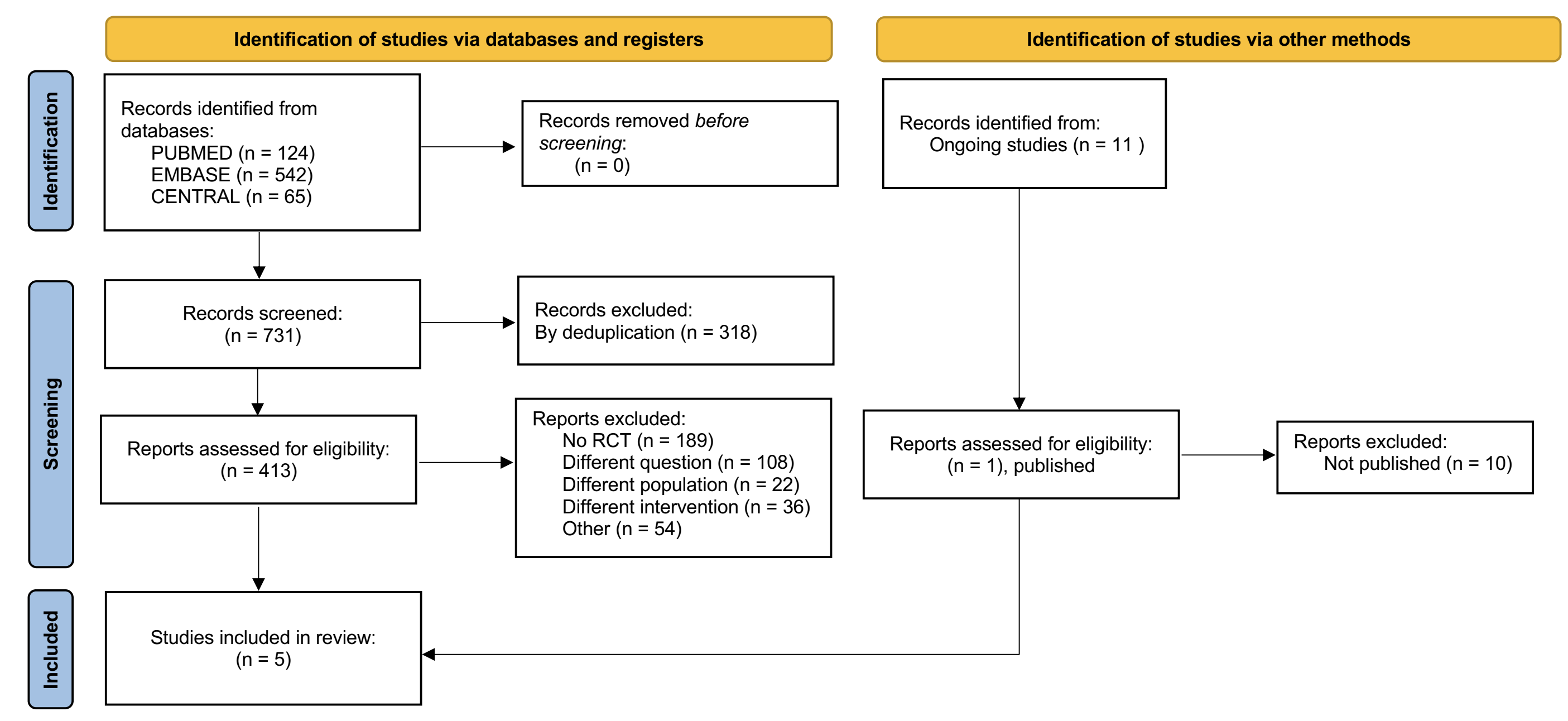
We recorded the reasons for excluding trials in any stage of the search and outlined the study selection process in a PRISMA flow diagram (Figure 1), which was adapted for the purpose of this project.
PRISMA flowchart.
Extraction and management of data
Using standardized forms created by authors in Microsoft Excel(R), two independent reviewers extracted data from each included and ongoing study. The included information is available elsewhere. We resolved disagreements by discussion, and one arbiter adjudicated unresolved disagreements.
Risk of bias assessment
The risk of bias for each randomized trial was assessed using the ROB 2.0 tool [28]. We considered the effect of assignment to the intervention for this review. Two reviewers independently assessed five domains of bias for each outcome result of all reported outcomes and time points. These five domains regarding bias are: bias due to 1) the randomization process, 2) deviations from intended interventions (effects of assignment to interventions at baseline), 3) missing outcome data, 4) measurement of the outcome, and 5) selection of reported results. Answers to signaling questions and collectively supporting information lead to a domain‐level judgment in the form of “low risk of bias”, “some concerns”, or “high risk of bias”. These domain‐level judgments inform an overall “risk of bias” judgment for each result. Discrepancies between reviewer authors were resolved by discussion to reach consensus. If necessary, a third reviewer was consulted to achieve a decision. The creation of the publication quality risk-of-bias assessment figures was carried out by means of rovis tool at:
Measures of treatment effect
For dichotomous outcomes, we expressed the estimate of treatment effect of an intervention as risk ratios (RR) along with 95% confidence intervals (CI).
For continuous outcomes, we used mean difference and standard deviation (SD) to summarize the data using a 95% confidence interval. Whenever continuous outcomes are measured using different scales, the treatment effect will be expressed as a standardized mean difference (SMD) with a 95% confidence interval. When possible, we multiplied the standardized mean difference by a standard deviation that is representative of the pooled studies, for example, the standard deviation from a well-known scale used by several of the studies included in the analysis on which the result is based. In cases where the minimally important difference (MID) is known, we presented continuous outcomes as minimally important difference units or reported the results as the difference in the proportion of patients achieving a minimally important effect between intervention and control.
Then, these results will be displayed on the “Summary of Findings (SoF) Table” [29] as mean difference.
Sensitivity analyses
Sensitivity analyses were planned but could not be performed due to an insufficient number of studies at low risk of bias.
Strategy for data synthesis
We planned to conduct a meta-analysis for studies clinically homogeneous using RevMan 5.4, with a random-effects model due to the expected clinical and methodological heterogeneity among the included studies. The search results and study selection are presented using flow charts and tables, in accordance with the PRISMA recommendations [24,25]. For any outcomes where it is not possible to calculate an effect estimate, a narrative synthesis is presented, describing the studies in terms of the direction and the size of effects, and any available measure of precision. For the main comparisons and outcomes, we prepare the GRADE SoF table [29].
Assessment of certainty of the evidence
The certainty of the evidence for all outcomes is appraised using the Grading of Recommendations Assessment, Development, and Evaluation working group methodology (GRADE Working Group) [29], across the domains of risk of bias, consistency, directness, precision and reporting bias. Certainty was adjudicated as high, moderate, low, or very low, assessed by two independent authors. For the main comparisons and outcomes, we prepared the SoF table [29]. We used GRADEpro GDT app to summarize assessments regarding the certainty of the evidence (available at:
We justified all decisions to downgrade the quality of studies using footnotes and made comments to aid the reader’s understanding of the review where necessary.
We used the cheat sheet-GRADE Informative statements to communicate the findings of the systematic reviews of interventions [30].
If missing data were identified, we attempted to contact investigators or study sponsors to verify key study characteristics and, where possible, obtain missing numerical outcome data. Where this was not possible, and we thought the missing data could introduce serious bias, we took this into consideration in the GRADE rating for affected outcomes.
We assessed the variations in treatment effect from the different trials by means of a formal statistical test (Q statistic) and the I2 statistic. We considered heterogeneity statistically significant if the p value is < 0.1. A rough guide to the interpretation of the I2 statistic given in the Cochrane Handbook [31] is: 0 to 40% might not be important, 30 to 60% may represent moderate heterogeneity, 50 to 90% may represent substantial heterogeneity and 75 to 100% considerable heterogeneity.
If inconsistency is high, this will be reported. If unexpected clinical or methodological heterogeneity is found for reasons that are obvious, we will state hypotheses regarding these for future versions of this review. We do not anticipate undertaking additional analyses in this version.
We planned to create and examine a funnel plot to explore possible small study and publication biases if we were able to pool more than 10 studies; no alternative method is planned.
We will update our living systematic review annually or sooner in the event of publication of practice-changing evidence (e.g., publication of a new trial, relevant presentations in conferences of the specialty, when the certainty of evidence or the magnitude or direction of the effect of an intervention importantly changes). Preprint publications will communicate the results of each iteration of our review. This approach adheres to best practices in updating living systematic review: it balances the need for up-to-date evidence with the time needed to ensure that the review is sufficiently rigorous, focuses our efforts on disseminating critical findings and maximizes the feasibility of the project.
We plan to conduct literature surveillance every six months using the search strategy presented in Supplementary material 2. We will use the selection, data collection, risk of bias assessment and analysis using methods described earlier. No changes to methods are currently planned for the next iteration.
We will retire our living systematic review when the evidence base becomes stable with few to no new trials, if we reach moderate to high certainty evidence for all interventions, or if we can no longer maintain the personnel needed to continue the living systematic review.
We intend to deposit all data in a public repository (e.g., Open Society Foundations registries) and publish each iteration of the living systematic review online.
Results
An initial search of the databases yielded a total of 731 records screened and one added after publication of an ongoing identified study. After the exclusion based on the title, abstract and/or full text in accordance with inclusion and exclusion criteria, five studies were deemed eligible for inclusion. The study selection process is summarized in the PRISMA Flowchart (Figure 1). The reporting bias assessment via funnel plot was not performed due to the small number of studies.
We included five randomized clinical trials [15,23,32,33,34] in this first version of this living systematic review, which included a total of 1050 randomized patients; the primary endpoint could not be assessed in 4 patients as declared by Mullens W. et [15]. The mean age of patients ranged from 67 to 80 years. Overall, 382 females (36,4%) were included. Between the patients that completed the trial, a total of 522 patients were co-administered acetazolamide, while the remaining 524 received loop diuretics alone. Acetazolamide was administered either orally or intravenously, at a daily dose of 250 to 500 mg. Baseline characteristics of the studies have been summarized in Table 1. Heterogeneity is reported by the I2 statistic and narrative synthesis.
We excluded 409 studies that did not fulfill our eligibility criteria. A detailed list of excluded studies with the reasons for exclusion is presented in Supplementary material 3.
We identified 10 ongoing ran evaluating the role of acetazolamide in acute congestive heart failure; however, upon closer examination, only 2 of these trials directly address the clinical question posed in our review, focusing specifically on the use of acetazolamide as an adjunctive strategy to enhance decongestion in patients with diuretic resistance. A detailed list of these ongoing studies is provided in Supplementary material 3.
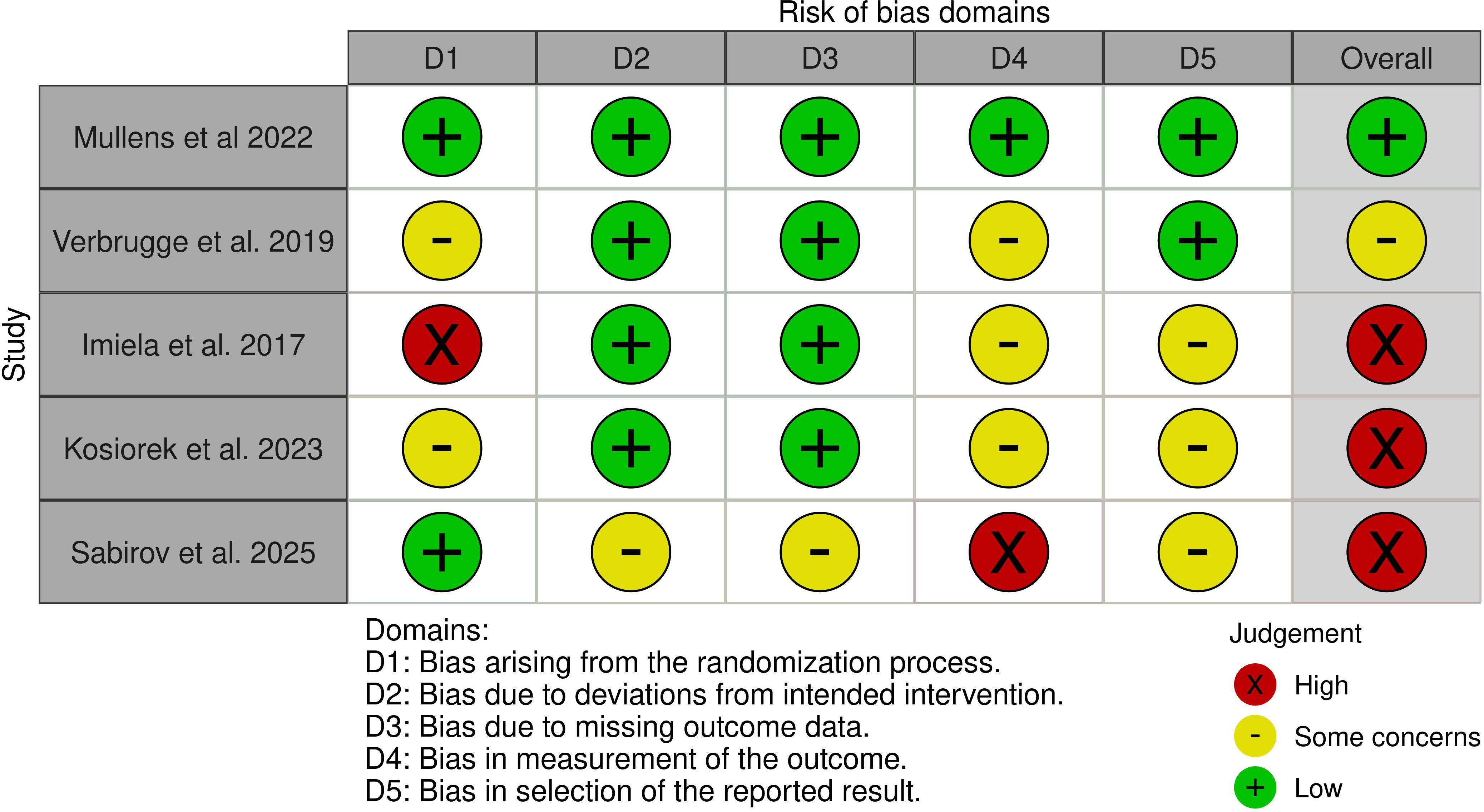
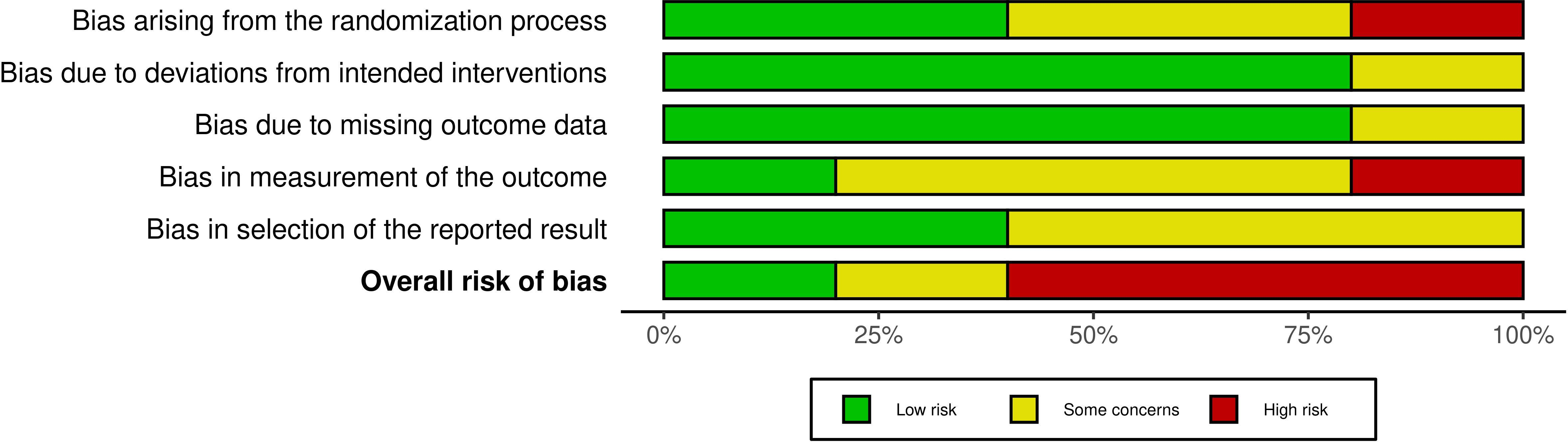
The risk of bias assessments are summarized in Supplementary material 4. According to the authors’ evaluations [33,33,34,34] and [23,23] were judged to be at high risk of bias, while [15,15] was judged to be at low risk of bias for all domains and [32,32] was judged to raise some concerns in at least one domain for this result. The overall distribution of risk of bias judgments is presented in Figure 2 and Figure 3. Sensitivity analyses were not performed due to an insufficient number of studies at low risk of bias.
Risk of bias traffic-light plot.
Risk of bias summary plot.
Decongestion at 72 hours
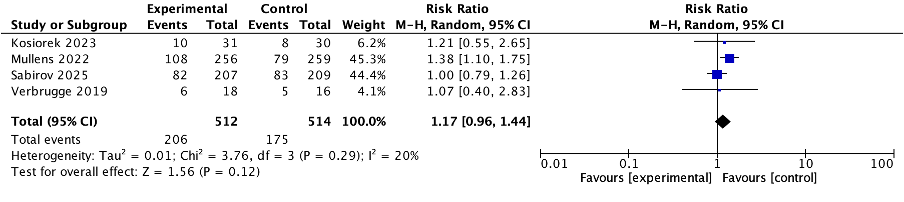
Four studies [15,23,32,34] examined the number of patients who achieved decongestion within 72 hours of beginning treatment. In the acetazolamide group, 206 of 512 patients reached decongestion, while 175 out of 514 participants of the control group reached it (relative risk: 1.17, 95% confidence interval: 0.96 to 1.44), as illustrated in Figure 4. There was low heterogeneity reported among the study results for this outcome (I2: 20%). The certainty of the evidence was judged as very low because of the very serious risk of bias of the included studies for this outcome and imprecision.
Effect of acetazolamide on decongestion at 72 hours.
Cumulative diuresis at 48 hours
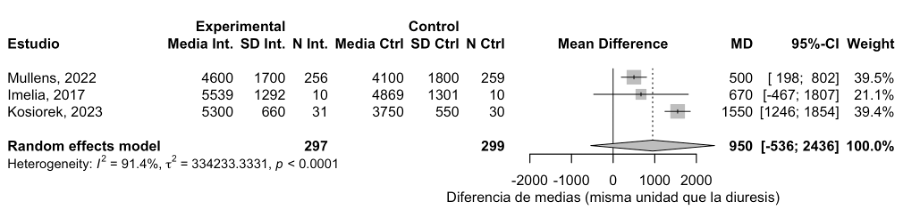
Three studies [15,33,34] reported cumulative diuresis within 48 hours of the beginning treatment. The group that received acetazolamide (297 participants) had a higher reported diuresis (mean difference: 950 mL, 95% confidence interval: -536 to 2436), as illustrated in Figure 5. There was high heterogeneity among the study results for this outcome (I2: 91.4%). The certainty of the evidence was judged as very low because of the risk of bias (high in two of the included studies), inconsistency and imprecision.
Effect of acetazolamide on diuresis at 48 hours.
Natriuresis at 24 and 48 hours
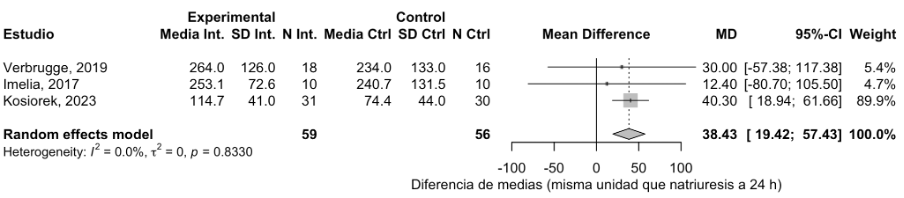
Natriuresis was assessed at different time points across the included studies. Three studies [32,33,34] reported natriuresis at 24 hours after intervention and four studies [15,23,33,34] reported natriuresis at 48 hours after intervention. Natriuresis at 24 hours was higher in the intervention group (total of 59 participants in the intervention group, mean difference 38.43, 95% confidence interval: 19.42 to 57.43), as illustrated in Figure 6. There was no heterogeneity reported among the study results for this outcome (I2: 0%). The certainty of the evidence was judged as low because of very serious risk of bias (two of the studies have high risk of bias).
Effect of acetazolamide on natriuresis at 24 hours.
Natriuresis at 48 hours was also higher in the intervention group (total of 400 participants in the intervention group, mean difference 42.66, 95% confidence interval: 9.70 to 75.61), as illustrated in Figure 7. There was high heterogeneity reported among the study results for this outcome (I2: 87%). The certainty of the evidence was judged as very low because of very serious risk of bias and inconsistency.
Effect of acetazolamide on natriuresis at 48 hours.

All-cause mortality
Three studies [15,23,32] assessed all-cause mortality differences between the intervention and control groups. No significant difference was found between the two groups (52 out of 481 patients in the intervention group, 42 out of 484 patients in the control group, relative risk 1.21, 95% confidence interval: 0.85 to 1.72), as illustrated in Figure 8. There was no heterogeneity reported among the study results for this outcome (I2: 0%). The certainty of the evidence was judged as very low because of the very serious risk of bias of the included studies for this outcome and imprecision.
Effect of acetazolamide on all-cause mortality.

Readmission due to heart failure
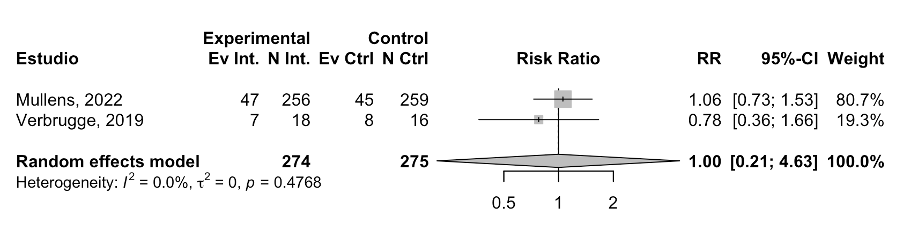
Two studies [15,32] evaluated the risk of readmission due to heart failure. No significant difference was found between the two groups (54 out of 274 patients in the intervention group, 53 out of 275 patients in the control group, relative risk 1.0, 95% confidence interval: 0.21 to 4.63), as illustrated in Figure 9. There was no heterogeneity reported among the study results for this outcome (I2: 0%). The certainty of the evidence was judged as low because of imprecision.
Effect of acetazolamide on readmission due to heart failure.
Worsening of renal function
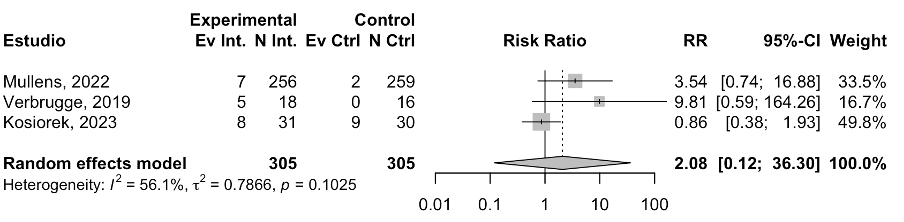
Three studies [15,32,34] assessed the worsening of renal function. No significant difference was observed between the two groups (20 out of 305 patients in the intervention group and 11 out of 305 patients in the control group, relative risk 2.08, 95% confidence interval: 0.12 to 36.30), as illustrated in Figure 10. Moderate heterogeneity was detected among the study results for this outcome (I2: 56.1%). The certainty of the evidence was judged as very low because of risk of bias (some concerns and high risk in two of the studies included for this outcome), inconsistency and imprecision.
Effect of acetazolamide on worsening of renal function.
We summarised the findings in SoF table (Figure 11).
Summary of findings.
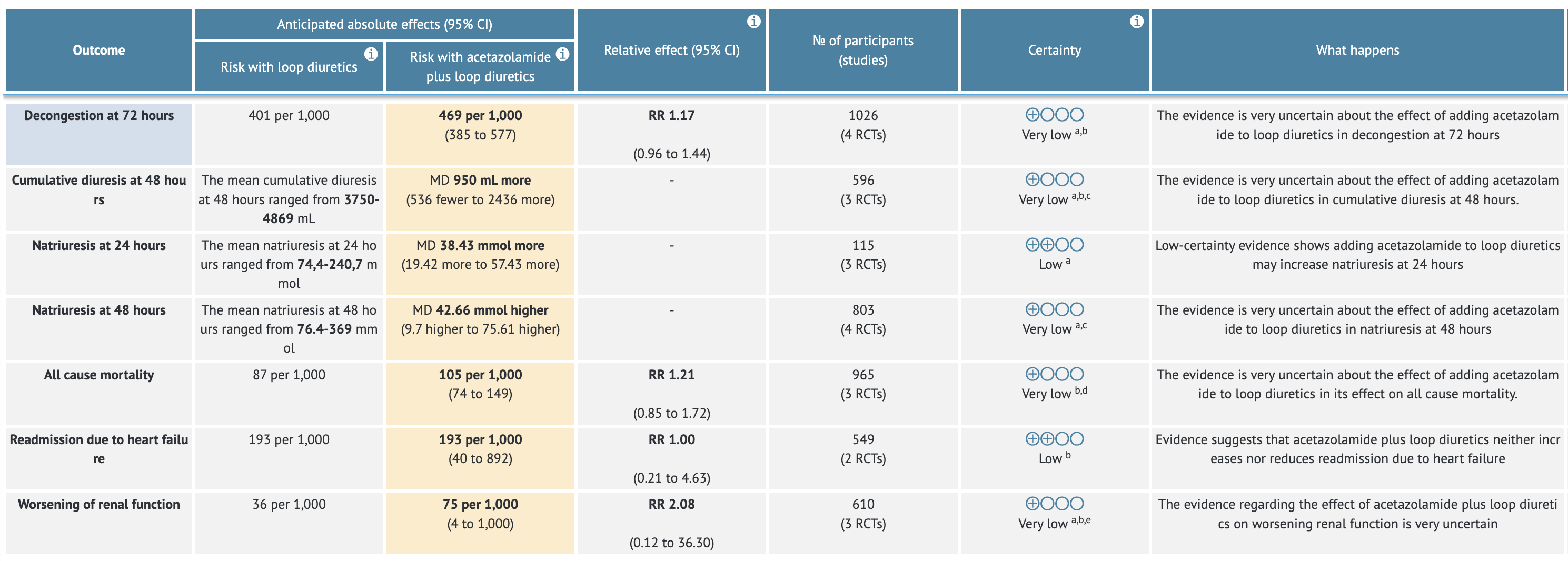
b Downgraded 2 levels for very serious imprecision.
c Downgraded 2 levels for very serious inconsistency.
d Downgraded 1 level for serious risk of bias.
e Downgraded 1 level for serious inconsistency.
CI: cofidence interval
Source: Prepard by the authors of this study.
Discussion
We conducted a comprehensive search of the literature in order to identify and summarize the evidence evaluating the effect of acetazolamide plus loop diuretics in patients with acute congestive heart failure. In this systematic review of five randomized controlled trials and 1050 randomized patients, the addition of acetazolamide to loop diuretics showed very low-certainty evidence for improved decongestion, low-certainty evidence to improve natriuresis and no demonstrated effect on mortality or rehospitalization. However, as a living systematic review, the conclusions remain provisional and may change as ongoing, adequately powered trials assessing longer-term outcomes are completed.
The evidence is very uncertain about the effect of adding acetazolamide to loop diuretics in decongestion. The heterogeneity in methods for assessing congestion constitutes a crucial methodological limitation that hampers the comparison of results across studies and the clinical interpretation of findings. This variability even extends to clinical practice guidelines. Given the strong association between residual congestion at discharge and increased risk of rehospitalization and mortality, current recommendations emphasize the use of repeated, multiparametric assessment strategies to guide optimal decongestion [6,35], which must be standardized in further studies.
The evidence regarding the effect of acetazolamide on diuresis in patients with acute congestive heart failure is very uncertain. A high degree of heterogeneity was observed across study results, which may be partly explained by differences in patient populations and in the acetazolamide dosing regimens employed. This systematic review assessed cumulative diuresis at 48 hours, but the absence of data at additional time points limits the ability to compare and detect meaningful differences. Furthermore, the timing and standardization of aquaresis assessment remains poorly defined in the context of decongestion, representing an important gap for both research and clinical practice. The discrepancy between studies highlights the need for more standardized diuresis protocols to reduce inconsistencies.
It is important to highlight that differences between intravenous and oral formulation of acetazolamide are not significantly relevant. Intravenous acetazolamide is not available in some countries. In addition, the difference in pharmacokinetics between intravenous and oral administration has not been studied for congestion, but it has been studied to reduce bicarbonate in patients with diuretic-induced metabolic alkalosis [36]. The study by Kosiorek et al. [34] presents encouraging findings concerning the diuretic and natriuretic reabsorption effects of a combined decongestive approach using oral acetazolamide in patients with acute congestive heart failure.
Low certainty evidence shows adding acetazolamide to loop diuretics may increase natriuresis at 24 hours, although its effect at 48 hours remains uncertain. The discrepancy between the results at 24 and 48 hours, together with the high heterogeneity observed in the studies concerning diuresis at 48 hours, could be a consequence of the dynamic nature of the renal response to diuretics and compensatory adaptations of the nephron over time [16]. The increase in sodium retention relative to water avidity in heart failure represents a key pathophysiological mechanism [37]. The action of acetazolamide in the proximal tubule is crucial to overcome diuretic resistance, which is often due to increased reabsorption in the distal segments of the nephron [16]. Furthermore, acetazolamide can counteract loop diuretic-induced metabolic alkalosis and hypochloremia, conditions that themselves reduce the natriuretic response [36]. Notably, sodium excretion is strongly correlated with 6-month mortality, whereas traditional fluid-based metrics including aquaresis show limited prognostic value. Impaired sodium excretion, even in the presence of fluid loss, is associated with worse clinical outcomes [37]. The lack of difference at 48 hours could indicate that renal adaptations or the magnitude of the acetazolamide dose was not sufficient to maintain differential natriuresis over the longer term in some study settings, highlighting a gap in our understanding of the optimal duration of therapy and the impact of dose on maintaining the response.
Very low and low-certainty evidence respectively indicates that the improvement in decongestion was not associated with reductions in mortality or heart failure–related readmissions. At 3 months, the absence of a significant effect on rehospitalization was consistent with the lack of impact on mortality, suggesting that the benefits of acetazolamide may be limited to the short-term phase of acute management. Several factors may explain these findings. First, with the exception of the ADVOR trial [15], the included randomized controlled trials lacked sufficient statistical power to assess long-term outcomes. Second, although faster and more effective decongestion may provide immediate symptomatic relief, these benefits could be overshadowed by the high burden of comorbidities and adverse events in this high-risk population over time. Third, the three-months follow-up may have been too short to capture potential effects of improved decongestion. Finally, the definition of “successful decongestion,” while clinically meaningful, is a composite endpoint that may not accurately reflect true volume status or predict long-term prognosis. Together, these limitations highlight persisting evidence gaps regarding whether acute decongestion strategies can translate into durable improvements in outcomes after hospital discharge [6].
The evidence regarding the effect of acetazolamide plus loop diuretics on worsening renal function is very uncertain. In the ADVOR trial [15], renal outcomes were similar between acetazolamide and placebo, while the DIURESIS-CHF study [32] reported more frequent transient increases in serum creatinine with acetazolamide. However, rises in creatinine during decongestive therapy do not always indicate permanent renal injury and may reflect effective decongestion.
This living systematic review identifies several critical gaps in knowledge concerning the management of acute congestive heart failure. The optimal dosing strategy, route of administration, and treatment duration have not been established. It is also unclear whether the benefits are consistent across different heart failure phenotypes, in patients with advanced renal dysfunction, or in those with a higher risk profile. Finally, the effect of acetazolamide on long-term outcomes such as mortality, rehospitalization, renal function, and quality of life remains uncertain. Furthermore, larger randmized controlled trials designed to assess long-term mortality and rehospitalization are needed.
This study has some limitations. First, only five studies were included in this meta-analysis; and most of the weight in the pooled analysis was carried by two of them [15,23]. Second, three of the studies [23,33,34] present high risk of bias and one [32] presents some concerns and there were not enough studies with a low risk of bias to perform a sensitivity analysis to account for unbiased reporting of results. Third, as the add-on therapy with acetazolamide is targeted, its long-term effects may be hard to evaluate as patients with heart failure are using other therapies and presenting other comorbidities, a situation which has not been analysed in the studies. Fourth, despite our comprehensive search strategy and living methodology, it is possible we will not identify all eligible randomised trials, especially because of the risk of missing eligible studies between update cycles as planned. Fifth, the living systematic review method as described remains challenging as an update team over time is needed.
Conclusions
In conclusion, current evidence from this systematic review suggests that adding acetazolamide to loop diuretics may increase natriuresis at 24 hours in acute congestive heart failure; besides, the evidence is still uncertain about the effect on decongestion. Interpretation is limited by heterogeneity in outcome assessment, the absence of standardized measures for decongestion and natriuresis, and the small number of available trials. Further adequately powered randomized studies are needed to clarify safety, interactions with other guideline-directed therapies, and potential effects on mortality and heart failure–related hospitalizations. As ongoing and future long-term trials are completed, these conclusions may change.