
Análisis
← vista completaPublicado el 26 de marzo de 2026 | http://doi.org/10.5867/medwave.2026.02.3173
Neurosis posmodernas: análisis desde la logoterapia
Postmodern neuroses: Analysis from logotherapy
Abstract
This article on critical hermeneutic methodology conducted an exegesis on the emergence of new neuroses described in the academic fields of logotherapy, philosophy, and social psychology in postmodernity, focusing on sociogenic and noogenic (spiritual) factors. To this end, the objective was to conduct an analysis of postmodern neuroses from the perspective of logotherapy, with a focus on sociogenic and noogenic origins. Guided by an existential analysis, it is understood that these postmodern neuroses contribute to the proliferation of a silent psychosocial malaise that originates in postmodern ideologies. Thus, this study was conducted from a metaclinical and paraclinical perspective, using logotherapeutic analysis to explore the ideological and social factors that give rise to these disturbances. Among these postmodern neuroses, we find algophobia as a generalized fear of human suffering, emotional hypochondria as the neurosis of constant happiness, narcissistic depression as the despondency of the performance subject, noogenic neurosis as the existential frustration of the era, and mass nihilism as emptiness and loss of hope in life. These neuroses provoke an existential crisis among postmodern social masses, which logotherapy views as a progressive loss of the values of self-realization and meaning.
Main messages
- From the perspective of logotherapy, postmodern neuroses are part of the paraclinical study of sociogenic, ideological, and metaclinical origins given in the noogenic factor.
- To date, Postmodern neuroses are not included in diagnostic manuals.
- Our work contributes to understanding the causes, symptoms, and consequences of postmodern neuroses through metaclinical and paraclinical classification, enabling the development of public and mental health policies that lead to more accurate prevention and intervention.
Introduction
Postmodernity refers to irrationality, the primacy of subjectivity and feelings over reason [1]. These concepts emerged in the 1950s among existentialist authors and psychoanalysts such as Jean Paul Sartre, Jacques Derrida, Sigmund Freud, Michel Foucault, among others. They understood that rationality could not explain true human nature and that the unconscious or subjectivity must be part of social construction. Therefore, under questioning of the use of reason, new ideologies emerged based on the primacy of feelings, drives, and desires, which gradually became established as new truths in society and education. To explain these new ways of thinking in postmodern ideologies, we can first discuss post-truth, a term added to the Oxford Dictionary in 2016 and to the Royal Spanish Academy (RAE) dictionary, denoting the use of irrational and subjective discourse [2]. This is how, in 21st-century society, human reason is gradually giving way to nominalist voluntarism, under the decree of personal desires and without objective truth as a higher value. From there, the psychopolitical subject is also constructed, who, based on a paradoxical strategy of freedom and self-seduction, submits to the constant consumption of life, with the exploitation of their sensations and emotions on the internet being an essential part of this process [3,4]. In this way, post-truth and the configuration of the psychopolitical subject in postmodernity have generated mass ideologies centred on subjectivity and the exploitation of desires.
Recently, reports of an increase in depression and anxiety in the iGen generation have been a consequence of postmodern ideologies centred on subjectivity and the exploitation of emotions [5]. These ideologies have promoted trends of emotional ultra-security through three major cognitive distortions or falsehoods of the mind, such as emotional reasoning (always listen to your emotions, they always guide you), polarisation of thought (the struggle of the bad against the good), and catastrophism (what doesn't kill you makes you weaker). Consequently, new postmodern ideologies are also based on emotional ultra-security, which makes the human psyche vulnerable and fragile in the face of adversity. Together with irrational discourse in post-truth and the exploitation of feelings through psychopolitics, emotional ultra-security is also part of a causal triad for the emergence of postmodern ideologies that affect mental health [3,5,6].
Within these postmodern ideologies, human beings are no longer conceived as solid, enduring projects, but as liquid, unstable, and empty beings who must constantly construct themselves in accordance with their desires and feelings [7,8]. Following the logotherapeutic approach, these forms of social processes that have emerged in postmodern ideologies, from philosophical reflections and contemporary social psychology, are conceived for our analysis as a paraclinical form of neurosis. This is the consequence of a sociogenic factor that, from an ideological, social, and political iatrogenesis, fosters a psychic pandemic in the masses of narcissism, consumerist self-seduction, and states of depression [9,10,11]. There is also another type of neurosis that logotherapy refers to as metaclinical. This manifests in the noetic (spiritual) domain, with doubts or existential crises due to a lack of meaning [12], which we examine in our reflection. This existential crisis among the postmodern masses is not pathological [9]. However, if no answers are found for a vital purpose, the person may become existentially frustrated and fall into a neurotic triad of the era, such as suicide, aggression, and addiction [13], among other disorders, such as anxiety and depression caused by a society in need of meaning [14]. These metaclinical factors can also manifest as social nihilism, leading to an emotional void and hyperactive apathy [15]. Figure 1 presents the analysis of the classification, origin, and symptoms of postmodern neuroses.
Postmodern neuroses.
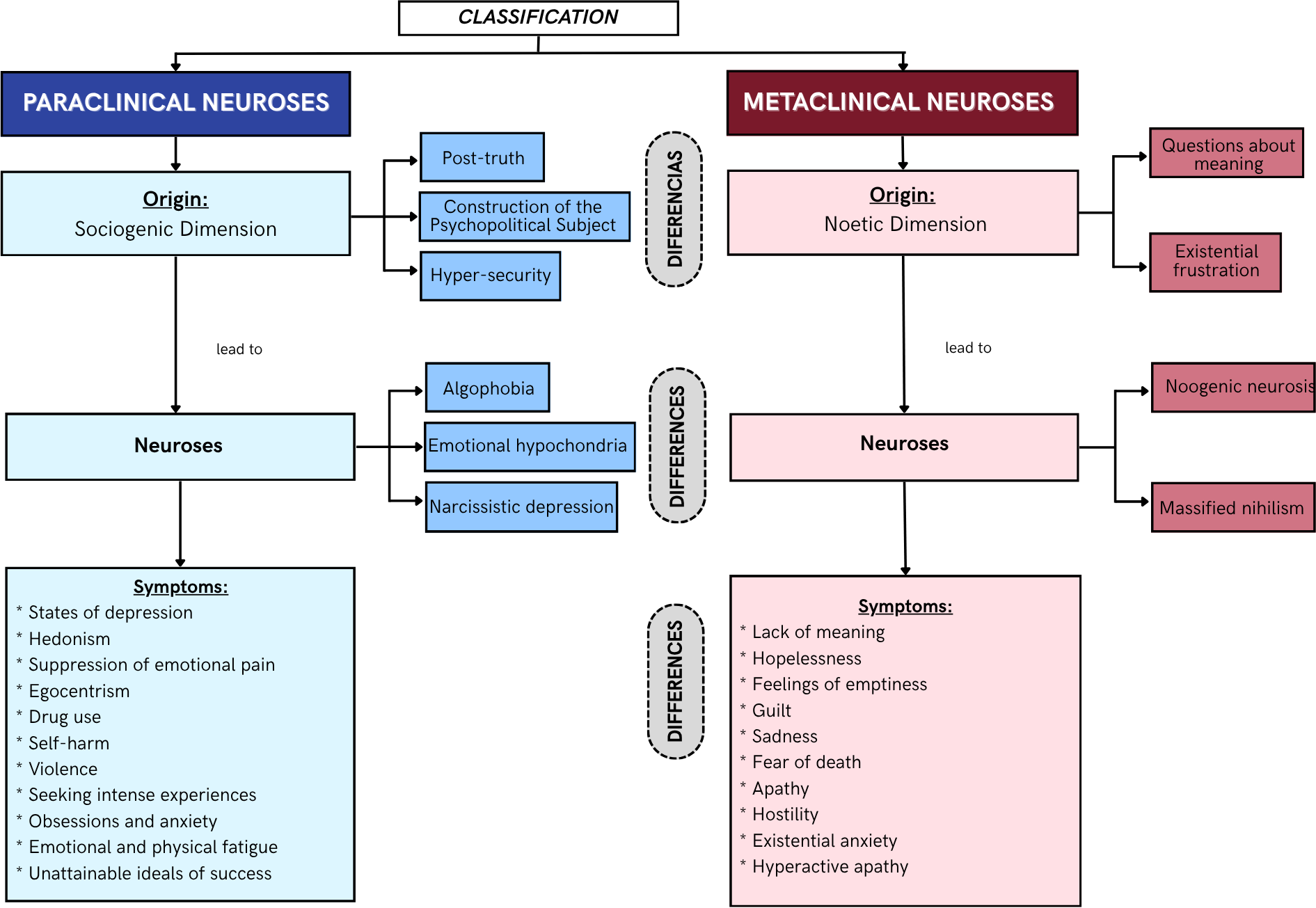
For all the above reasons, the rationale behind this study is individualised mental health, which does not warn about pathogenic or existential ideological structures that lead to neurotic symptoms. Thus, exploring the causes, symptoms, and classification of these neuroses can open up a new field of study within social psychology and mental health. For this reason, a critical hermeneutic research method was chosen, which led to the analysis of a social reality that has been little studied to date in the academic field. Therefore, the objective that guided the research was to analyze postmodern neuroses of sociogenic and noogenic origin from the perspective of logotherapy. To this end, the social ideological characteristics of algophobia, narcissistic depression, and emotional hypochondria were first addressed from a paraclinical category of analysis. In a second stage, the second category was analysed from a logotherapeutic metaclinical perspective, with the noetic factor being an existential crisis of the era leading to noogenic neurosis and mass nihilism. Finally, in a third stage, the prospects for mental health of the study of postmodern neuroses were analysed.
Paraclinical postmodern neuroses
An analysis of our times reveals, in the psychosocial, political, and educational context, symptoms of a proliferation of lightweight ideologies and new fads of self-worship [7], alongside a growing palliative policy that suppresses all types of suffering as narrative [16]. All this, under a government of algorithms or an infocracy of virtual scenarios, typical of mass self-seduction [8]. Likewise, some ideological notions that conceive of human beings as perverse, anthropocentric, and patriarchal are discourses that spread from academia and become widespread in society, creating resentment, frustration, depression, and hostility in people [17]. Psychologist Jordan Peterson refers to the disseminators of these ideologies as the self-proclaimed judges of the human race. He uses this expression to describe the bias or intellectual myopia of these arguments, advocating for an improvement in mental health: abandon ideology [18].
On the other hand, ideologies that sell happiness and success in education and society [19], together with an imperative of constant performance to achieve self-realisation [20], also generate a paraclinical or sociogenic problem in postmodernity, leading to existential frustration [11]. From a sociogenic factor, these descriptions of a symptomatic-sociogenic nature generate new paraclinical neuroses because they are given from an ideological-social sphere. These neuroses can also be related to loss of meaning (noogenic) and mass nihilism, which is considered a noetic or metaclinical factor. However, its study is fundamentally rooted in social and political ideologies (paraclinical).
Within these postmodern paraclinical neuroses, we can mention the following, as reported in the analysis of academic literature:
Algophobia
Palliative society and excessive positivity bring with them a psychological phenomenon called algophobia, or a generalised fear of suffering and effort. This is increasingly prevalent in Western societies as part of a primary loss of meaning in life [16]. When man’s vital purpose is silenced, the body becomes more important than the spirit. This is why algophobia is perceived as a state of constant optimisation of the performance of the psyche and the body, where suffering generates phobia. Furthermore, this is seen as part of censorship or discarding [3], at a time when everything is reduced to the ideology of performance and the constant optimisation of life. For a palliative society, suffering cannot have any value, and only the positivity of new pleasurable experiences and constant success can be part of human fulfilment. Byung-Chul Han points to everything that is part of our narcissism as an excess of positivity. This is understood as projections of a personalisation that always makes us prefer the hell of sameness, given by our individualistic desires, preferences, and aspirations [21], in a society that offers us pills or painkillers for pain, but no real meaning for the soul in the face of suffering.
The symptomatic characteristics of algophobia can be glimpsed in three sociogenic symptoms:
Emergence of a hedonistic body and psychology
as a result of a psychopolitics [16] where the soma and psyche become fragile and vulnerable due to the privilege of positive experiences over negative ones. The absence of negativity and distancing from all pain, as evidenced by terms such as 'toxic person' or 'emotional toxicity' [22], indicates an aversion to and distancing from people and experiences that may cause emotional pain, making the person’s psyche more vulnerable to real challenges, problems, or conflicts. Within this symptom, there is also a law of least effort [23] based on automatic, poorly reasoned decisions driven by feelings and emotional reasoning (System 1), which cause less pain or effort to a lazy cognitive system (System 2) accustomed to psychological hedonism, the law of least effort also being one of the traps of today’s society and education [24]. Within the soma, this symptom takes the form of an exhibition of the body’s positivity, presenting itself as polished and as aesthetically pleasing as possible, even if only in appearance [25], resorting to physical preparation, massages, and all kinds of dietary practices that make it hedonistic and subjective [26]. The body is transformed into an instrument of subjectification, marked as unique and recycled through aesthetic operations [7]. Therefore, within algophobia, the body is given special worship and enjoyment, which is positive, but at the same time hypersensitive to effort and pain [16].
Cancellation of pain and division of social ties
fostered by an individualism where solidarity is diluted, and suffering is understood as personal failure [27]. At this point, emotional distress is silenced and internalised, resulting in loneliness and despair, giving way to depressive states that intensify over time [28,29]. Thus, the priority of positivity forces the individual to achieve their own happiness and pleasure, silencing pain [30]. In doing so, they renounce an authentic meaning of life and the construction of true social bonds [3]. Responsible for their own success, individuals with algophobia consider the ephemeral promise of triumph and personal empowerment, without suffering and atomized. This is how silent pains, which hide human suffering, become more present as symptoms of loneliness, narcissism, and selfishness [30].
Intense experiences or paroxysmal enjoyment
these symptoms are found in intense experiences that seek to awaken the person from a life anaesthetised by the rejection of pain. Byung-Chul Han refers to drug use, self-harm, violence, and extreme sports as mechanisms of overcompensation for a body and soul anaesthetised from human suffering [16]. This reflects the need for stimulants to feel alive and awaken from the boredom [13] left by postmodernism and contemporary nihilism.
Emotional hypochondria
Emotional hypochondria is another characteristic of paraclinical symptoms that can be reported within the new postmodern neuroses. Cabanas and Illouz define emotional hypochondria as a state in which subjects are concerned with themselves and their happiness, focusing on properly managing their emotions and abilities [19]. Constant self-monitoring and excessive concern about emotional well-being feed back into this hypochondria, generating obsessive worries and anxiety that are remedied by so-called psychotherapeutic marketing through the consumption of emotional support products [23] such as ontological coaching, self-help manuals and the new promises of disciplines such as yoga and reiki, among others, which combat so-called negativity or emotional toxicity [22] with positivity based on authenticity and constant reinvention. This creates individuals who are adept at psychotherapeutic marketing techniques, as personal self-realisation is never-ending.
Narcissistic depression
This type of depression is a narcissistic illness characterised by a pathological relationship between the self and the logic of performance and success [28]. Likewise, this disturbance of the performance society reflects the fatigue of the self under the standards of its ideal self, unfulfilled by the deliberate demand for constant production [31]. This sociogenic malaise, also called success depression, explains how despondency does not come from a relational failure with the world, but from a constant pattern of self-affirmation of one’s own ego [28], generating the violence of self-aggression against oneself due to the void of meaningful object relations [32]. At this closed point, individuals find themselves isolated in an endless confirmation of their own self, without access to anecdotes or experiences that can transcend them [25].
Among the symptoms of this narcissistic depression, we can glimpse two: fatigue from the overload of the self and unrealistic standards of success and ideals. Both are part of postmodern ideologies that emphasise the individual’s self-seduction in their constant, endless self-realisation. It is a utopia that evokes a malaise typical of the collective unconscious, akin to the myth of Sisyphus.
Fatigue is the first symptom of success depression, as the individual, overburdened by themselves, aspires to constant self-improvement [31], leading to exhaustion typical of a society of fatigue [32]. As a result, individuals remain stuck in their ideals of the self, seeking happiness that never comes or is very fleeting, continually building themselves up in a never-ending process of self-realisation and self-actualisation [22]. Fatigue in the society of fatigue is characterised by constant frustration and anxiety, as the task of success remains unfinished.
On the other hand, neural violence is common in a society of positivity, given an excess of performance that generates fatigue, hyperactivity, and disorders that affect mood [20]. These characteristics are not only found in the individual’s constant self-realisation, but also in their sense of play, as the devices they use to distract themselves or play subject them to a constant state of being busy, constantly producing or updating themselves.
Byung-Chul Han calls the large amounts of information that the performance subject currently has to process 'information fatigue syndrome' [33]. This psychopolitics of infomania, or the excess of ephemeral, rapid information that individuals consume in postmodernity to distract themselves, play, or stay always up to date, generates nomophobia and FOMO (Fear of Missing Out). Both phenomena unconsciously enslave them through self-seduction to new postmodern forms of addiction. The fatigue experienced even during rest periods in relation to entertainment or internet updates can leave the brain exhausted, as psychologist Daniel Goleman reports, leading to an excess of attention to multiple tasks and the mind wandering among many stimuli without a fixed point of attention [34]. The excess oxygenation and blood currently required by mobile phones and constant information consumption mean that the brain needs more than 20% of these elements (beyond normal standards) to concentrate. This results in simultaneous activities and entertainment being carried out in multitasking [20], where the person attends to more than one activity in parallel. This creates a psychopolitics of egocentric, exhausted, hyperactive, and stressed people in a world of constant updating and consumption for self-realisation.
The second symptom refers to standards of success and unattainable ideals that constantly revolve around new and higher expectations in a consumer society. Sanabria Galvis refers to this, saying that "the negative dynamics of desire lead us to dissatisfaction and melancholy. Once the object of desire is achieved, it is not enough; another new object of desire will appear, increasingly distant and unattainable" [30]. Here, frustration and depression constitute the final process of this dynamic of desire. Being individuals concerned with finding themselves (emotional hypochondria) and with being recognised by others, the task of finding oneself becomes unattainable, leading to a hyperintention to be happy. This hyperintention is produced by a will to power and pleasure [35], which atrophies a will to meaning, which occurs in the forgetting of oneself, towards the surrender of a task or people [36]. Narcissistic depression constrains the field of axiological values by prioritizing a primary search for satisfying sensations and personal well-being. In this way, vital values with a predominance of the corporeal [37] and psychological self-gratification are established as the purpose of an axiological field reduced to the sensible and neurotic by its own hyperintention to achieve happiness and well-being.
One consequence of standards of success and unattainable ideals is seen in the technological dimension. The constant flow of information has turned the subject into a consumer product, where external recognition becomes an imperative need. In this new digital environment, individuals exploit themselves in search of recognition, in a logic of personal performance that is masked as freedom [38]. This results in a feeling of loneliness and emptiness in emotional life [39,40] in postmodern societies.
Postmodern metaclinical neuroses
From a metaclinical perspective, the noetic or spiritual dimension and doubts about the meaning of existence are studied, which, according to Victor Frankl, can become noogenic neuroses [9]. In this type of neurosis, we can observe non-pathological symptoms [41] such as hopelessness, emotional despondency, feelings of loneliness and boredom, stemming from an existential crisis (frustration of meaning) that afflicts postmodernity due to the lack of paradigms or beliefs that solidify a sense of purpose and values. Consequently, human beings in this era feel more anxiety and uncertainty, navigating constant chaos [42], shaped by the massification of contemporary social ideologies that silence true awareness of the meaning of life.
Noogenic neurosis
Questions or doubts about the meaning of existence should not be considered pathological, since reflecting on the meaning of life is a conscious human act, according to Victor Frankl [12]. But when this search is frustrated, a noogenic neurosis can occur, which is characterised by hopelessness and a feeling of meaninglessness. Frankl [9] states that "it is a specific neuroticism, namely noogenic neurosis, which derives etiologically from the feeling of absurdity, from the doubt that life has meaning, from the despair that such meaning exists at all" [9].
According to Baron and Kohnen (2023), this problem becomes evident when subjects show conflicts in their emotional well-being due to a lack of direction or meaning in life [43]. However, this should not be pathologised or confused with a social mental health problem, as these experiences of existential emptiness and frustration are common, especially in adolescents and young people who are in a stage of formation, identity, and purpose [14], until they find a true purpose in life in the face of their existential problems. An example of this is the case of adolescents with spinal cord injuries in Brasilia, who discovered, as part of their existential frustration with the conditions of their illness, a degree of independence and decision-making as a spiritual resource of strength in the face of adversity [44].
Noogenic neurosis can be positive in the socio-affective sphere and in terms of personal maturity, because it seeks the deepest meaning to continue living fully despite the conditions or adversities that every human being must face. Therefore, detecting such frustration or noogenic neurosis allows us to understand "the inner achievement of meaning or its denial" [43], taking into account the relationship between the openness of self-realisation values and the world and others.
Human beings suffering from an existential crisis should not be viewed solely from the perspective of biological or psychological disturbance. In this context, Rocamora states that "logotherapy does not investigate the cause of the illness, but rather focuses on the person’s attitude towards the morbid condition" [45]. At this point, suffering must be seen as an opportunity to find meaning in life rather than simply pathologised. Given the social conditions of postmodernity and the denial of ontological being that accompanies this trend, this phenomenon is increasingly part of a problem of psychiatrisation [14] due to its similarity to symptoms of depression or anxiety, such as hopelessness, feelings of emptiness, guilt, sadness, or fear of dying, among others.
Mass nihilism
An absence of values and transcendence characterises mass nihilism. Life becomes absurd due to human mortality. This same absurdity, which Albert Camus raised in his works, governs as a new postmodern model of mass thinking [46]. Postmodern ideologies attempt to give meaning to the feeling of absurdity through new values of life optimisation and constant happiness, which become a chimera. Values such as short-term consumerism and hedonism, the power of money and status, among others, are delivered through ideologies such as scientism and capitalism, which are rooted in contemporary nihilism [47]. These privilege hyperproduction, the fetishistic seduction of things, constant desire, and the technicality of the additive [48] over the ideographic and noetic understanding of people. All narrative as ontology of being is lost [49], giving way to the positivisation (quantification and constant performance) of the individual within post-industrial society.
The opening up to a society of production, the optimisation of life, immediacy and positivisation [45,47] brings non-pathological consequences such as loneliness, apathy, hopelessness and emptiness, coupled with a feeling of the absurdity of life [46,48,50] typical of contemporary nihilism. The feeling of loneliness, for example, experienced in postmodern societies, also manifests itself in empty hypercommunication through a digital panopticon that lacks narration as an event of meaning of the other as a subject [21,49,50]. Apathy and despair arise under agenesis subjectivity, a term added by Romero [48] to refer to subjects of hypermodernity, with difficulties in projecting themselves into the future, absorbed in a fateful continuity, in an ever-present [48]. Likewise, the characteristics of this agenesis subjectivity include paranoia, with the accelerated pace of society generating a sense of competition, hostility, and selfishness, typical of individualism, which engenders nihilism [48,50].
Agenesis subjectivity also manifests itself in emptiness or existential angst, as another non-pathological trait, derived from the progressive loss of the essential foundations of values and traditions that gave people security [11,47]. The consequences of this existential emptiness are a crisis of meaning in life and a vital discouragement that causes distress and even depression [50,51]. However, this non-pathological characteristic does not originate in the psychological or organic realm, but rather in the noetic dimension, where the absurdity of life is understood through widespread mass nihilism in the West. This is necessary to differentiate it from noogenic neurosis, given that the latter is non-pathological, as existential questions and the frustration that can be felt are part of human beings' conscious nature. Mass nihilistic thinking denies the truth and importance of these questions and answers, finding them absurd and empty, as a pathological way of life. This is where individuals silence their meaning and adopt a constant experimentation with life, without commitment, self-transcendence, vocation, values, history, morality, and religion [46,47].
The future of mental health concerning postmodern neuroses
For Mark Fischer, mental health is currently reductionist, in that it decontextualises its problems into a privatised, individual model [52]. This is how an isolated subject is treated within their society, with psychobiological or family determinants, yet without addressing the social and existential structures that give rise to new pathologies of the era, such as paraclinical and metaclinical neuroses [9]. With this in mind, comprehensive mental health should also include a study of the determinants of social systems, thus identifying the ideological factors and cultural causes [53] that lead to neurotic pathologies in the masses.
Based on a logotherapeutic approach in a current context, such as postmodernity, mental health would also have to be directed towards a rehumanised psychotherapy, as referred to by Victor Frankl [54], which is oriented towards building, discovering, and sustaining a meaning of life as part of an existential therapy for the prevention of the neuroses described [55]. Likewise, to guide the projection towards new public health policies that help reduce or prevent postmodern neuroses, it is necessary to recognise that social and ideological structures give rise to pathologies specific to the era.
Providing a metaclinical and paraclinical classification of postmodern neuroses can help recognise their causes and consequences and delve deeper into their symptoms. This makes it possible to identify them and address them with public and mental health policies that lead to more accurate prevention and intervention for this type of neurosis. This is particularly relevant, given that they are not currently included in diagnostic manuals.
Considering this approach to studying and classifying psychological distress in the future would facilitate understanding of contemporary psychological distress and its treatment in clinical practice. This would take it beyond theory and give it practical value. In a psychological consultation where we observe complaints of continuous anxiety about emotional well-being, states of depression due to lack of success at work, and a vague feeling of emptiness, we may be led to investigate their aetiology and classification in social-ideological or existential sources. Currently, in many scenarios, this suffering is usually addressed at a symptomatic level [56], neglecting the sociocultural and existential factors involved. Under this classification proposal, it could be explored as part of a paraclinical neurosis, linked to pressure to perform at work or the demand for social success in an individualistic cultural system [57].
In this instance, intervention may focus on psychoeducation, analysing the social mandates of imposed success and strengthening a reflective stance towards suffering, avoiding classifying or labelling it as a conventional clinical pathology. However, if intense experiences of emptiness due to a lack of meaning arise during the therapeutic process, the approach would require a metaclinical understanding of suffering.
At this point, clinical intervention transcends the symptomatic and would focus on encouraging the individual’s ability to make sense of adversity and pain. This is particularly noticeable in the contexts of existential disorientation that characterise late modernity [58]. Thus, following the fundamentals of logotherapy, interventions could be more sensitive and tailored to the complexity of psychological suffering, without symptomatic reductionism of other kinds.
Conclusions
Postmodern neuroses arise from contemporary ideologies. According to our analysis, these are based on three strands reported in academic literature: post-truth as irrational discourse, psychopolitics as narcissistic self-seduction for constant consumption, and emotional ultra-security that seeks to censor suffering as a human narrative with palliative policies. From this foundation, postmodern ideologies proliferate in subjectivity and the centring of an egocentric self, giving rise to postmodern neuroses conceived as an ideological factor called paraclinical by logotherapy, as part of a sociogenic aetiology or social unrest.
Paraclinical neuroses described as algophobia, emotional hypochondria, and narcissistic depression are part of the subjectivist ideologies and egocentric self that proliferate in the postmodern masses. These are based on a repression and denial of human suffering as discourse and meaning in algophobia, on the proliferation of obsessions, and anxiety for an optimisation of emotional life in emotional hypochondria. Added to these are the standards of competitive success ideals, which promote exhaustion and despondency in narcissistic depression.
Our analysis also focused on metaclinical neuroses that address the noetic dimension of the human being, including noogenic neurosis and mass nihilism. These neuroses are non-pathological and manifest themselves in questions about the meaning of existence, which can generate frustration, hopelessness, emptiness, and apathy when no vital purpose is found. One point of difference between noogenic neurosis and mass nihilism is that, in the former, people may question or doubt the purpose of their existence. In contrast, in the latter, the conception of life is already a response to an a priori absurdity and meaninglessness.
Finally, future contributions and debates that build on postmodern neuroses may strengthen a new field of study within mental health and social psychology. This responds to new reasons in their aetiology, such as the ideological and existential structures that lead to social unrest.