
Artículo de revisión
← vista completaPublicado el 21 de agosto de 2026 | http://doi.org/10.5867/medwave.2026.07.3225
Aplicación de herramientas bioinformáticas genómicas en la psiquiatría clínica y su asesoramiento
Application of genomic bioinformatic tools in clinical psychiatry and counseling
Abstract
Genomic medicine has introduced transformative tools for psychiatric practice, facilitating the diagnosis of complex cases through the identification of genetic variants. The gene encodes a key component of the histone methyltransferase complex. Mutations in this gene have been linked to neurodevelopmental disorders and schizophrenia, particularly in cases with early onset and cognitive impairment. The aim of this article is to describe the application of genomic tools and international criteria for interpreting genetic pathogenicity in psychiatric clinical practice, using as a model. Based on an illustrative clinical case of a 13-year-old patient with psychotic symptoms, we conducted a comparative analysis of two single-nucleotide variants in (c.2209C>A and c.2209C>T). Genomic databases (Ensembl, ClinVar, gnomAD) and prediction tools (PolyPhen-2, MutationTaster, Align-GVGD) were used, following the American College of Medical Genetics and Genomics guidelines. The c.2209C>T (nonsense) variant was classified as pathogenic due to its truncating effect and prior reports. In contrast, the c.2209C>A (missense) variant, initially of uncertain significance, was reclassified as likely benign after a familial segregation study showed the variant was inherited from an unaffected parent. The integration of genomic tools allows for a precise approach to neuropsychiatric phenotypes. However, bioinformatic analysis must be complemented by clinical correlation and cosegregation studies. Finally, genetic counseling is emphasized as an essential process to integrate technical findings with the psychological and educational needs of the patient and their family.
Main messages
- Genomic medicine tools can be applied in psychiatric practice to facilitate accurate diagnosis in atypical psychiatric cases.
- We present a fictional case of a 13-year-old boy with a psychotic disorder associated with cognitive impairment, who carries the c.2209C>A variant in the SETD1A gene.
- We describe pathogenicity analysis using genomic databases and in silico prediction tools, emphasizing the role of cosegregation analysis.
Introduction
In psychiatry, the patient’s medical history and family history remain the cornerstone of the evaluation when a psychiatric disorder is suspected, as various studies have demonstrated the significant role of genetic inheritance [1], particularly for neurodevelopmental disorders and severe mental disorders such as bipolar affective disorder and schizophrenia [2]. In this regard, a genetic correlation among psychiatric disorders has been demonstrated, a finding that suggests the existence of shared biological mechanisms [3].
Genomic medicine in psychiatry has led to major advances and the incorporation of new tools into clinical practice, including pharmacogenetically guided drug prescribing [4], along with the diagnosis of more complex and specific cases. In this regard, the use of genomic databases is essential, as they compile genomic, molecular, phenotypic, clinical, and population-based information on multiple genetic variants that have been evaluated for their pathogenicity [5]. Pathogenicity helps determine how likely a variant is to cause a disease, based on criteria such as the variant’s frequency in the population, an assessment of the function of the affected gene or protein, the type of alteration it may cause, and whether it was inherited or arose de novo. This information helps distinguish a spectrum of possibilities ranging from benign to pathogenic [6]. In the clinical context, this information is included in genetic reports requested when a hereditary condition is suspected; therefore, a general understanding of it is useful for providing information and counseling to the patient and their family.
In a previously published article, we discussed general concepts in genetics, genetic and genomic databases, and their application in psychiatry; we also presented a fictional clinical case to illustrate these concepts [7]. In this article, based on that clinical case, we present an assessment of the pathogenicity of the variants identified and the relevance of genetic counseling.
Analysis and interpretation of genetic information in clinical practice
Below, we present the fictional case of a 13-year-old patient who presented with mental symptoms atypical for his age (Box 1). He has a family history of bipolar affective disorder. Genetic testing was ordered as part of his management [7].
Illustrative clinical case to be developed throughout the article
A 13-year-old male patient is evaluated, with a history of low-average IQ —according to a previous psychometric evaluation— and attention deficit hyperactivity disorder. His family history includes a father with bipolar affective disorder diagnosed at age 25. The mother mentions that three months ago she noticed a significant change: her son has lost interest in going to school, spending time with his friends, and doing things he used to enjoy. She notes that he used to enjoy playing soccer, but no longer shows any excitement for attending his matches. She notices that he has been more withdrawn and serious, leading her to fear that he may be experiencing depression. She is concerned that it is no longer just her who has noticed this; her son’s teacher has also told her that he is being bullied at school. Despite this, he does not seem bothered by these incidents. In addition, over the past month, his mother has noticed “strange behaviors,” such as talking to himself or being overly concerned about his three-year-old cat, refusing to be separated from her to the point of asking to take her to school every day for fear that something might happen to her while she’s alone. The patient states that he is certain his cat is close to death because she is sleeping more than usual, so he does not want to lose a single minute without her. He also says that the veterinarian hates him because he refuses to tell them “the truth” about his cat, insisting that she is healthy. The lack of depth in his discourse is striking. The doctor rules out a depressive episode, as the patient shows no signs of sadness, irritability, behavioral changes, sleep disturbances, changes in appetite, or other suggestive symptoms. Nor are there any signs of restricted interests or a history of socialization problems. A psychotic episode, likely within the schizophrenia spectrum, is suspected due to the associated negative symptoms (flattened affect, social withdrawal, anhedonia, alogia). Given the characteristics of the presentation—which occurred earlier than the most common age of onset and is characterized by concomitant executive function deficits—as well as the history of a first-degree relative with a similar condition, the treating physician suspects a monogenic etiology.
Source: Prepared by the authors of the manuscript. Taken from the article by Vargas et al. [7].
An initial approach was to search the Online Mendelian Inheritance in Man database (OMIM,
Since there was no evidence suggesting an abnormality in a specific chromosomal region, a comparative genomic hybridization array (CGH array) was requested to identify chromosomal rearrangements with high resolution across the entire genome. However, this test was negative, ruling out the presence of chromosomal microdeletions or microduplications. Therefore, whole-exome sequencing was performed to identify changes involving one or more nucleotides that are not detected by comparative genomic hybridization. Whole-exome sequencing identified the single nucleotide variant (SNV) C>A in SETD1A (SET domain-containing protein 1).
Following the identification of the SETD1A variant, information was sought regarding its function, the alterations associated with its mutation, and related diseases.
SETD1A is located on the short arm of chromosome 16 (16p11.2) [8]. It encodes a protein that is a component of the histone methyltransferase (HMT) complex, an enzyme that catalyzes methylation of histone H3 lysine 4 (H3K4), thereby promoting gene transcription [9].
Some studies suggest that mutations in SETD1A may affect synaptic function and neuronal development. De novo mutations and inherited variants of this gene have been identified in individuals with early-onset epilepsy [10]. Likewise, the role of de novo mutations has been investigated in individuals with neurodevelopmental disorders, speech impairments, dysmorphic facial features, and psychotic symptoms such as hallucinations, delusions, and thought disorganization. Some authors have proposed that SETD1A mutations confer a biological vulnerability to a broad spectrum of neurodevelopmental disorders [11,12].
Specifically, in the case of schizophrenia, a study using whole-exome sequencing that included more than 4000 participants with schizophrenia found that rare loss-of-function variants in SETD1A cause schizophrenia [13]. Given the function of SETD1A, dysregulation of the H3K4 methylation pathway may be involved in the pathogenesis of schizophrenia [13], being associated with structural alterations like aberrant somatodendritic morphology, functional changes involving glutamatergic neurotransmission, and mechanistic alterations mediated by increased cyclic AMP signaling [11].
Once the gene and the identified variant are known, it is necessary to determine the significance of the findings reported in the patient’s genetic analysis. To this end, we will discuss the criteria used to establish pathogenicity and the methods employed for their evaluation.
The interpretation of genetic variants poses a major challenge; therefore, establishing standardized criteria is essential to achieve an accurate diagnosis with appropriate genotype–phenotype correlations.
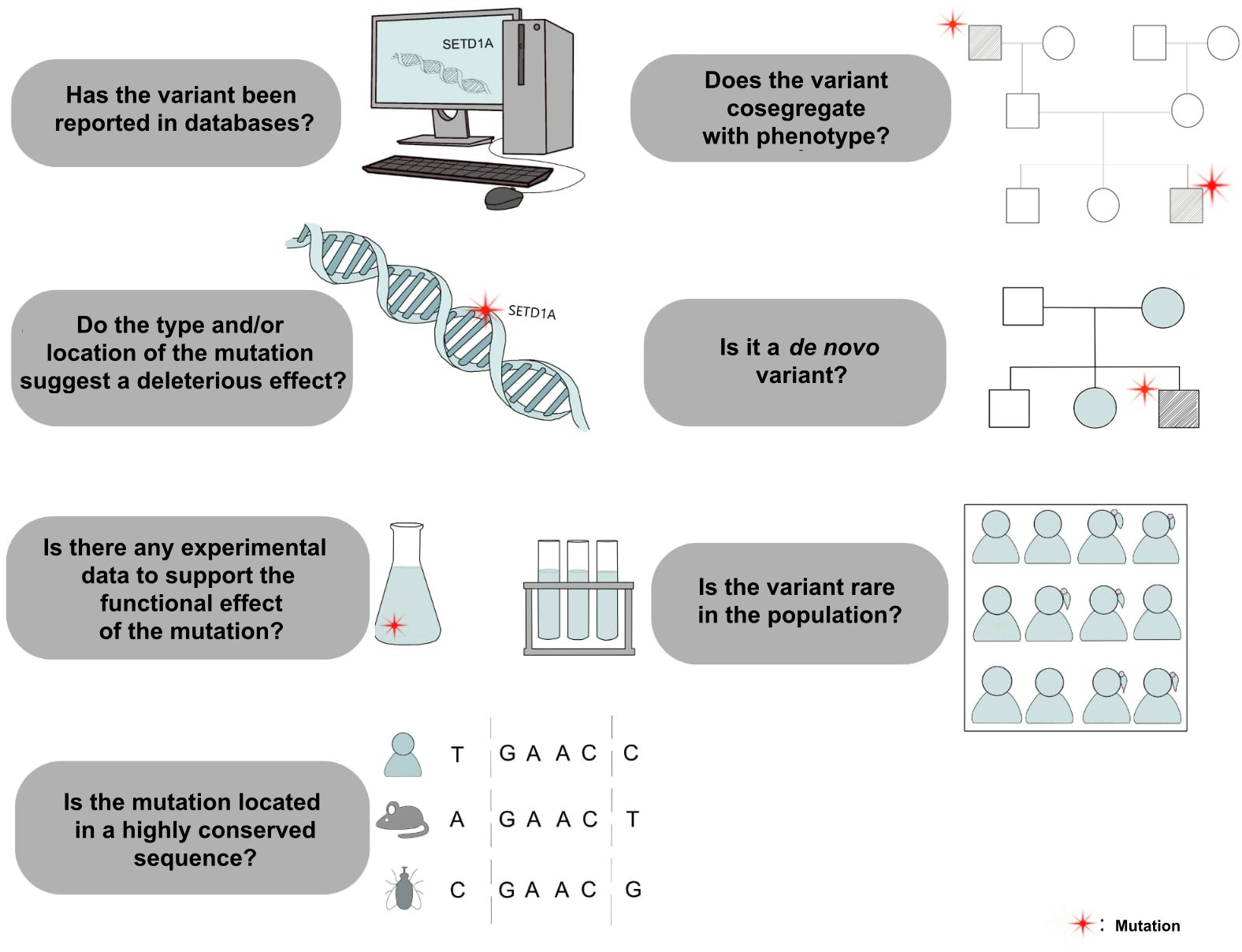
The American College of Medical Genetics and Genomics (ACMG) [6] developed criteria for pathogenicity and benignity based on variant characteristics. The result allows a variant to be classified as benign, likely benign, pathogenic, likely pathogenic, or of uncertain significance (VUS). The latter represent a significant challenge in sequencing studies, since their pathogenic role cannot be definitively established or ruled out. For these cases, as well as for likely pathogenic variants, clinical interpretation criteria have been proposed (Figure 1), including variant type, familial segregation, allele frequency, in silico prediction of functional effect, and evolutionary conservation (Table 1).
Pathogenicity criteria established by the American College of Medical Genetics and Genomics.
Source: Prepared by the authors.
Two single-nucleotide variants were compared using multiple genomic databases, most of which were described in the first article [7]. Both variants were located at position 2209 of the coding region, differing only by a single nucleotide substitution. In the C>A mutation, cytosine is replaced by adenine, whereas in the C>T mutation, cytosine is replaced by thymine (Table 2).
In the Ensembl platform (
After selecting the transcript in which the variant was described (SETD1A-201), the nucleotide sequence can be viewed in the upper-left menu by selecting “Sequence, cDNA” from the subheading, which displays the DNA nucleotide sequence of the transcript reconstructed from its RNA (Figure 2).
Effect of the genetic variant on the amino acid sequence.
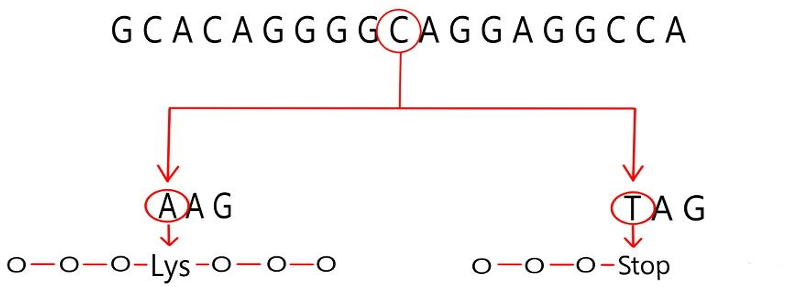
The genetic variant identified in the patient (C>A) resulted in the substitution of the amino acid glutamine by lysine. This variant had not been previously reported. Meanwhile, the variant reported in Ensembl and ClinVar at the same nucleotide position (C>T) generates a premature stop codon (stop gained).
When reviewing the variant previously described in the literature (C>T), its clinical significance was classified as pathogenic. However, there is no evidence for the C>A variant, suggesting that the patient may have a novel variant. This mutation is a missense mutation, as it involves an amino acid substitution (glutamine to lysine). In addition, the protein properties change, since glutamine is an uncharged polar amino acid, whereas lysine is a positively charged polar amino acid. In the case of the C>T mutation, a premature stop codon (nonsense mutation) is generated, suggesting pathogenicity.
The National Center for Biotechnology Information (NCBI) platform provides information linking the patient’s disease (schizophrenia) to the gene of interest (
The search can also be performed directly through Online Mendelian Inheritance in Man (OMIM) (
When searching ClinVar using the terms “Schizophrenia AND SETD1A,” the C>T variant was classified as a pathogenic mutation. However, there were no matches for the C>A mutation. Consequently, it was confirmed that the latter variant is novel (
The Genome Aggregation Database (gnomAD) can also be used. It compiles genetic variants observed in the general population and aims to harmonize and provide access to data from various large-scale sequencing projects. To search for allele frequency in the population go to
In addition, gnomAD allows users to view the distribution of gene variants recorded in ClinVar, with filters by mutation type. The data were filtered for missense mutations that were not classified as variants of uncertain significance. This yielded information on 92 missense mutations that had been reported as clinically significant. Of these, 82 were benign or likely benign, and 10 were pathogenic or likely pathogenic.
- PolyPhen-2. After reviewing the databases, PolyPhen-2 is a useful tool for predicting the potential impact of an amino acid substitution on a protein’s structure and function (
http://genetics.bwh.harvard.edu/pph2/ ). The platform requires the protein or SNP identifier (SETD1A), the position at which the amino acid change occurs (position 737 for the C>A variant), and the amino acid change. In this case, AA1 changed from Q (glutamine) to AA2 K (lysine). The prediction was “POSSIBLY DAMAGING.” It was not possible to make this prediction for the C>T variant, since the platform does not allow the evaluation of an amino acid change resulting from a stop codon. - MutationTaster. Another useful tool is MutationTaster (
https://www.mutationtaster.org/ ). We selected “Specific transcript” and then filled in the fields with the name of the gene and the transcript of interest, as well as the sequence—which requires entering a pair of bases around the variant. For the C>A variant, “AGGGG[C/A]AGGA” was entered, and the result indicated that the variant is benign. However, for the C>T variant, the result was deleterious (equivalent to pathogenic). In addition to providing a potential pathogenicity classification based on computational parameters, this tool allows us to determine, among other characteristics, the degree of protein conservation across various genomic databases. For the C>A variant, the degree of protein conservation indicated that it is identical in chimpanzees and cats. For the C>T variant, the degree of protein conservation showed that this variation is identical in chimpanzees, while it was found to be partially conserved in cats and pufferfish. Furthermore, ClinVar classified this variant as pathogenic. - Align-GVGD. Finally, the Align-GVGD tool (
http://agvgd.hci.utah.edu/about.php ) was used. This platform combines the biophysical properties of multiple amino acid sequence alignments to predict the severity of amino acid substitutions across a spectrum of probabilities of protein function disruption. Predictions range from Class C0 (least likely to interfere with protein function) to Class C65 (most likely). For the C>A variant, the predicted classification was Class C45. This tool could not be applied to the C>T variant because it does not evaluate amino acid changes resulting from premature stop codons.
For the C>A variant, all the available evidence proved insufficient to reach a definitive conclusion. For this reason, additional information was obtained through family studies by analyzing the cosegregation of the variant with the phenotype of interest. In other words, we examined whether other affected individuals in the same family carried the same variant, while unaffected individuals did not. In our case, we determined that the index case’s father was affected by a disorder related to his son’s (bipolar affective disorder) and that the family consisted of a mother and an older brother, both of whom were unaffected. Thus, if it had been verified that the father carried the same mutation as the affected son (in a heterozygous state), while neither the mother nor the brother were carriers, this would have confirmed the familial cosegregation of the mutation. Upon analyzing this family, the father did not carry the C>A variant, but the mother was a carrier; therefore, a lack of cosegregation was observed.
Results
The following table summarizes the information obtained from the various databases that were used to classify the variant (Table 3).
The classification was based on the scores assigned according to the various criteria. The criteria were categorized as supportive (1 point), moderate (2 points), strong (4 points), and very strong (8 points). The calculation is performed by subtracting the sum of the points for benign rules from the sum of the points for pathogenic rules, yielding a total score that assigns a hierarchical pathogenicity classification from highest to lowest score as follows: “pathogenic” (10 points or more), “probably pathogenic” (6 to 9 points), “variant of uncertain significance” (0 to 5 points), “probably benign” (-6 to -1 points), and “benign” (equal to or less than -7 points) [14].
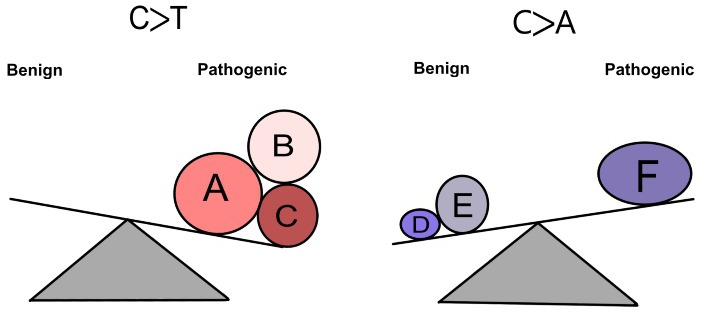
After applying the methodology to the SETD1A mutation, the result showed that the C>T variant is indeed pathogenic, while the C>A variant, following an expanded family study, was classified as likely benign (Table 4 and Figure 3).
Weighting of pathogenicity criteria.
Source: Prepared by the authors of the article.
Genetic counselling
Genetic testing has various implications for the lives of individuals and their families. It facilitates better care planning, aids in reproductive decision-making, enables the development of strategies to delay the onset of symptoms in mutation carriers, allows for early diagnosis, and reduces anxiety caused by uncertainty [15,16]. However, the increasingly frequent identification of genetic variants of uncertain significance poses new challenges for patients and their families [17]. In individuals with neuropsychiatric disorders, the genetic factors that play a causal role in the condition interact with environmental events such as social or academic stressors, affecting their behavior and their ability to adapt to the different environments in which they live. In this context, understanding the origin of their symptoms helps them develop a sense of identity and facilitates the identification of a treatment plan and prognosis [15].
In the reported case, the role of a genetic variant was analyzed in light of various pathogenicity criteria, and it was concluded that the variant was likely benign. This finding should be communicated to both the patient and his or her family, in accordance with the principles of genetic counseling.
Genetic counseling is the process of helping people understand and adapt to the medical, psychological, and family implications of the genetic contributions to a disease [18,19]. In this process, the central objective is the effective communication of genetic information, which requires an appropriate and empathetic therapeutic relationship focused on collaboration and consensus regarding goals [20]. There are two approaches to genetic counseling that must be combined: counseling and education. The expected outcomes in the psychological dimension are: healthy adjustment, empowerment, behavioral change, and satisfaction with decisions [21,22]; while in the educational dimension, the expected outcomes are information retention, appropriate risk perception, and knowledge, along with an understanding of medical concepts [18]. In practice, most genetic counseling sessions focus on education, emphasizing the provision of biomedical information regarding the genetic diagnosis and its implications [18]. However, the counseling approach that emphasizes the psychological dimension of the process is associated with more significant outcomes and a greater impact on the educational aspect [18,19].
Conclusions
In this article, we have explored the use of genomic bioinformatics tools in psychiatric practice, using SETD1A as a model for the analysis and interpretation of variants. The standardized criteria of the American College of Medical Genetics and Genomics allow genetic findings to be classified along a spectrum of pathogenicity, relying on the use of genomic databases and in silico prediction tools that assess the effect of the variant. These resources are essential for clinicians to discern the functional impact of specific mutations in patients with neuropsychiatric disorders presenting with atypical clinical features.
Analysis of the clinical case demonstrated that identifying a variant through whole-exome sequencing is only the beginning of a rigorous evaluation process. The importance of family cosegregation studies was emphasized to validate the pathogenic role of a mutation within the patient’s family tree, with family history and medical history serving as the fundamental clinical pillars upon which any genetic finding must be interpreted.
Likewise, genetic counseling was addressed as a comprehensive process that must combine the provision of technical information with empathetic counseling.
Through the application of genomic medicine, psychiatric practice can be enriched to provide real, precise, and personalized benefits for patients and their families, using precision medicine as a link to a deep understanding of the genetic architecture of neuropsychiatric phenotypes.