
Artículo de revisión
← vista completaPublicado el 3 de septiembre de 2026 | http://doi.org/10.5867/medwave.2026.08.3240
Impacto del cateterismo vesical intermitente limpio en calidad de vida y consumo de recursos en pacientes con lesión medular y complicaciones urológicas: revisión narrativa
Impact of clean intermittent catheterization on quality of life and resource utilization in patients with spinal cord injury and urological complications: A narrative review
Abstract
Objective To synthesize the international evidence on the impact of clean intermittent catheterization on quality of life and resource utilization in patients with spinal cord injury and urological complications, to support a review of policies that shift the financial burden of catheterization to families in Chile.
Methods A narrative review based on the MEDLINE/PubMed database and gray literature published between 2014 and 2025, in Spanish and English. The research question was structured using the population, concept, and context framework. Two search algorithms were applied, combining MeSH terms, free-text keywords, and Boolean operators. Screening was conducted in three successive stages (title, abstract, and full text), with a second reviewer resolving any uncertainties by consensus.
Results After screening 880 references, 65 studies met the inclusion criteria. Findings were organized into five dimensions: patient quality of life, caregiver quality of life, urinary tract infections, resource use, and emerging care models. Based on this evidence, an archetype of the chronic catheter user was developed: a man aged between 25 and 45 with a traumatic spinal cord injury, who uses a wheelchair in more than 67% of cases, spends more than 53 minutes a day on catheterization, has a prevalence of urinary tract infection exceeding 50% (two-thirds of which are antimicrobial resistant), and reports a 36% dissatisfaction with his urinary quality of life. Furthermore, he reuses catheters primarily for economic reasons; 90% of patients who used reusable catheters preferred switching to single-use catheters, and 84% reported greater satisfaction. Multiple cost-effectiveness analyses show that hydrophilic single-use catheters are cost-effective or dominant strategies in high-income settings. Caregivers -mostly mothers or partners- report insufficient training, social restriction, and work-related difficulties that the healthcare system fails to address.
Conclusions Access to appropriate catheterization supplies, combined with structured patient and caregiver education and continuity of care, improves quality of life, reduces urinary complications, and is cost-effective. Chile’s current policy of shifting the financial burden of catheterization to families is inconsistent with the available international evidence.
Main messages
- In Chile, no public funding program covers the supplies needed for clean intermittent bladder catheterization, shifting the financial burden to patients with spinal cord injuries who already face a heavy clinical, functional, and social burden.
- This narrative review synthesizes 65 international studies and proposes a chronic user archetype integrating clinical, social, economic, and caregiver dimensions into a coherent and feasible profile for policy design.
- The scarcity of specific data for Chile and Latin America requires extrapolating evidence from developed institutional contexts, limiting the direct applicability of cost-effectiveness estimates.
Introduction
Spinal cord injuries are a public health problem of growing importance, both globally and in Chile. The updated global map of the epidemiology of traumatic spinal cord injuries (2011) estimates an incidence rate of approximately 25 cases per million people in South America [1]. A systematic review of 229 studies worldwide estimated a global incidence rate of 23.77 per million people, with variations by type: 26.48 per million for traumatic injuries and 17.93 per million for non-traumatic injuries [2]. For Chile, the prevalence was estimated at 104 732 people with spinal cord injury in 2016 [3], while other estimates put the figure at 45 000 cases for 2019 [4]. The condition predominantly affects men (approximately 78% of cases) and has a bimodal age distribution: a first peak among young adults and a second among those over 60 [5].
A common and clinically significant consequence of spinal cord injuries is neurogenic urinary tract dysfunction. This impairs the patient’s ability to voluntarily empty the bladder and requires intermittent clean catheterization, a procedure that empties the bladder by inserting a catheter through the urethra [6]. The proportion of people with spinal cord injury who require this procedure ranges from 38.7% to 60%, depending on the context and healthcare system [7,8,9].
Clean intermittent catheterization is internationally recognized as the standard of care for neurogenic lower urinary tract dysfunction because it is associated with lower rates of urinary tract infections and urethral trauma than indwelling catheters [10,11]. However, its proper implementation requires sustained access to adequate supplies, education for the patient and their caregiver, and environments that allow the procedure to be performed independently and with dignity. In Chile, no public funding program (neither the Explicit Health Guarantees system (GES) nor the National Health Fund (FONASA)) currently covers the necessary supplies. This gap forces a significant proportion of patients to reuse catheters or bear the cost themselves, which affects their quality of life, generates significant out-of-pocket expenses, and results in costly complications for the public healthcare system.
The objective of this study was to synthesize the available international evidence on the impact of clean intermittent catheterization on quality of life and resource utilization among patients with spinal cord injury and urological complications, and to develop a chronic user archetype. The results aim to support a review of the current strategy, which shifts the financial burden of catheterization onto families in Chile.
Methods
A narrative review was conducted, for which two research questions were formulated in accordance with the population, concept, and context (PCC) strategy. This was defined as:
-
Population: adult patients with spinal cord injury and urological complications who regularly use clean intermittent bladder catheterization.
-
Concept: impact on quality of life and drivers of expenditure.
-
Context: home care and outpatient management.
The search explored MEDLINE/PubMed using two algorithms that combined MeSH terms, free-text terms, and Boolean operators. The first algorithm cross-referenced spinal cord injury and intermittent catheterization with quality of life; the second combined the condition with descriptors of costs and economic burden to answer the following two research questions: What is the impact on quality of life associated with clean intermittent bladder catheterization in patients with spinal cord injury and urological complications? What resource utilization (cost drivers) is identified in national and international guidelines for the management of clean intermittent bladder catheterization in patients with spinal cord injury and urological complications? (Supplementary Material 1).
The search was restricted to studies published between 2014 and 2025, with full text available in Spanish and English, excluding preprints and articles focused exclusively on pharmacotherapeutic mechanisms. A snowball sampling strategy and the inclusion of gray literature were also applied to control for publication, selection, and observation biases. Screening was conducted in three successive stages (title, abstract, and full text), with a second reviewer resolving any cases of doubt by consensus. Data extraction was performed using a standardized spreadsheet that collected the following information: author, year, country, study design, population, sample size, and main findings by dimension. An assessment of methodological quality is not part of the design of this study.
The evidence was organized into five dimensions: patient quality of life, caregiver quality of life, urinary tract infections, resource use, and emerging care models. These dimensions reflect the initial screening of the evidence that pointed in these directions, including the possibility of emerging categories as part of the method’s iterative process.
An archetype was constructed using the “person” technique, which originated in interaction design [12] and was adopted by service design [13,14], specifically in its “literature-based person” variant, which synthesizes secondary evidence rather than primary data [14]. Clinical, social, economic, and caregiver attributes reported consistently across the 65 studies were included, prioritizing findings supported by more than one independent study [14]. This adaptation did not include direct validation with patients or clinicians.
Results
A total of 880 references were identified, of which 65 met the inclusion criteria (Figure 1) [15]. Of the included studies, 53.8% were published between 2020 and 2025, 38.5% between 2015 and 2019, and 7.7% in 2014. Geographically, the Americas (driven largely by the United States and Canada) accounted for the largest share (44.6%), followed by Europe (32.3%), Asia (15.4%), Oceania (6.2%), and Africa (1.5%). Most studies are descriptive or analytical designs (29.2%), followed by clinical trials (21.5%), evidence reviews (21.5%), qualitative or community intervention studies (15.4%), economic evaluations (9.2%), and clinical consensus statements or guidelines (3.1%). The detailed distribution is shown in Table 1.
PRISMA-ScR-based flowchart for study selection.
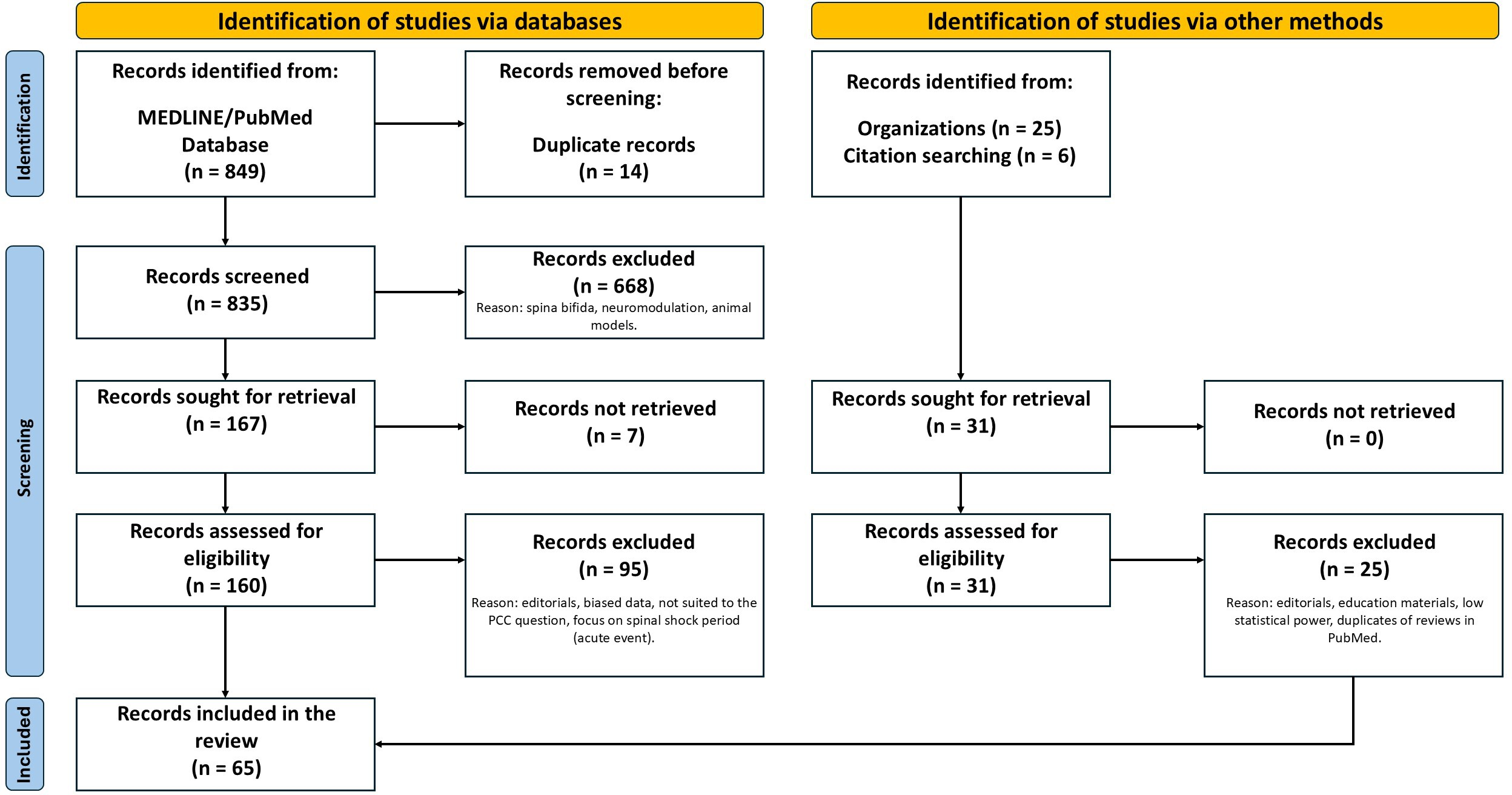
Source: Prepared by LENZ Consultores (2025).
Patient quality of life
Urinary problems are one of the main difficulties reported by people with spinal cord injuries and have a significant impact on quality of life [16]. A Korean study involving 169 patients found that, although intermittent catheterization was the method most recommended by physicians (47%), nearly 50% of patients did not follow this recommendation, primarily due to financial constraints (22%) and a lack of a caregiver (14%); 43% reported using diapers, 21% used condoms or plastic bags to collect urine, and 63% required medication for urinary complications [16].
Satisfaction with urinary quality of life is low. In a North American cohort of 753 patients undergoing clean intermittent catheterization, 36.1% reported dissatisfaction, which was significantly associated with female sex (odds ratio: 1.63; 95% confidence interval: 1.15 to 2.31), recent injuries ([c12.1][c13.1] [c14.1]p significant), four or more urinary tract infections per year (odds ratio: 2.36; 95% confidence interval: 1.47 to 3.81), and severe bowel dysfunction (odds ratio: 1.42; 95% confidence interval: 1.02 to 1.98) [17]. The burden of catheterization extends into the nighttime: 42% of patients in a Belgian study of 79 participants required nighttime catheterizations, with lower quality of life (as measured by the SF-36 questionnaire) in paraplegic patients compared to non-paraplegic patients [18]. The transition from incontinence to intermittent catheterization has been shown to have a positive effect. In a Slovak study, quality-adjusted life years increased from 9.02 to 17.45 after six months of follow-up, accompanied by a 38.5% reduction in urinary incontinence (p < 0.01) [19].
Practical barriers also significantly impact autonomy and social life. The main obstacles are poor access to adequate restrooms outside their homes [20], difficulties in scheduling the procedure during the day [21], and limited availability of wheelchair-accessible restrooms [22]. A Spanish study reported that 98% of respondents felt self-conscious about self-catheterization, and 16% avoided visiting family or friends [23]. The average time spent on the procedure is 53.4 minutes per day [22].
Women report greater technical difficulties when using a wheelchair or requiring assistance from a caregiver [22]; the time for each catheterization session increases to 20 minutes, compared with averages of 8.2 minutes for independent women and 8.8 minutes for men [24]. More than 40% of patients have motor limitations in their upper extremities that hinder their ability to perform the procedure independently [22,25].
The type of catheter affects quality of life. The frequency of catheterization ranges from four to six times daily [26,27], with a documented risk of urethral trauma due to improper use of catheters and lubricants [27]. It is important to recognize that experiences vary among patient groups. For example, a Japanese study reported that 6.3% of patients had to catheterize more than nine times a day, with each catheterization taking more than 20 minutes [28]. In a Danish clinical trial, switching from single-use to reusable catheters resulted in a 28% decrease in the quality-of-life score (p < 0.001); 90.9% expressed a preference for returning to single-use catheters [29]. Switching to hydrophilic catheters results in clinical improvements and high overall satisfaction (84.1%) [30], whereas reuse requires additional lubricant and temporary packaging precautions, which negatively impact quality of life [31].
Emotional and educational factors also influence quality of life. Lack of technical knowledge, embarrassment, pain, a sense of loss, and negative stigmas make it difficult to perform the procedure correctly, especially among women [22,32]. Meanwhile, clear language, understandable educational materials, and hands-on training in the procedure promote learning and patient safety [32,33]. Among the main obstacles to achieving self-catheterization are resistance from the patient or caregiver, inadequate equipment, previous negative experiences, and moderate to severe intellectual disabilities [22,34]. In the United States, only 48.1% of nursing professionals involve a family member or caregiver when teaching the technique [35].
Caregivers quality of life
The burden on caregivers is an aspect that receives little attention but is of great clinical and social significance. A Turkish study found that 100% of pediatric caregivers were mothers, and although 76.2% had received technical training, 78.6% considered it insufficient, leading them to rely on trial and error. Furthermore, none received training from nurses or home follow-up after hospital discharge [36]. A qualitative study found that most caregivers were unfamiliar with the technique before using it and felt isolated, lacking even support from their partners [37]. Most reported restrictions on their social lives [37] and difficulties at work, although educating employers facilitated continued employment [38]. Anxiety is also frequently reported. Sari & Demirbağ [36] documented higher levels of anxiety among caregivers whose children had three or more urinary tract infections during the last trimester (p < 0.05) [36].
Urinary tract infections
Urinary tract infections are the most common complication among people with neurogenic lower urinary tract dysfunction [39]. There is no consensus on how a catheter should be cleaned between uses or how many times it can be reused [40]. Intermittent bladder catheterization is associated with lower rates of urinary tract infections than indwelling catheters [10]. In patients with spinal cord injury who use intermittent catheterization, the prevalence of symptomatic urinary tract infections is estimated to be over 50%, and that of asymptomatic infections is estimated to be 10% [41]. A study based on a large U.S. cohort reported that, during the first year after diagnosis, 31.3% developed lower urinary tract infections and 1.7% developed upper urinary tract infections; these figures rose to 36.4% and 2.2%, respectively, in the subgroup with spinal cord injury. Furthermore, 66.6% of the cultures from these symptomatic infections showed resistance to multiple drugs [41,42]. Elliott et al. reported a urinary tract infection rate of 70%, with 1.63 episodes per year, and a 5.73-fold increased risk of hospitalization with five or more episodes per year [9]. The period before the start of catheterization is characterized by high infection rates that decrease progressively, with a baseline of 9.4 symptomatic urinary tract infections per patient per year, and 22.84% of these infections being febrile and requiring hospitalization [43,44]. The main associated complications are autonomic dysreflexia, present in 91% of people with complete tetraplegia [45], and urethral stricture in 4.2% of patients [46].
The type of catheter influences the incidence of urinary tract infections [47]. The American Urological Association guidelines recommend using hydrophilic catheters because they are associated with a lower risk of infection and urethral trauma [11]. A study of 1000 patients in Saudi Arabia showed significantly higher annual rates of symptomatic urinary tract infections with uncoated catheters (79.6% versus 46.6%) [48]. Systematic reviews confirmed a lower risk of urinary tract infections with hydrophilic catheters (relative risk = 0.84; 95% confidence interval: 0.75 to 0.94; p = 0.003) [49], along with less urethral trauma and greater patient satisfaction [11,50]. De Ridder et al. showed that 82% of polyvinyl chloride (PVC) catheter users experienced urinary tract infections, compared with 64% of hydrophilic catheter users (p = 0.02) [51], and in a multicenter trial, the score on the Intermittent Self-Catheterization Questionnaire (ISC-Q) score increased significantly upon switching to disposable hydrophilic catheters (58.0 to 67.2; p = 0.0101), with 83% preferring to continue using them [52].
Evidence on the impact of catheter type on urinary tract infections favors disposable hydrophilic catheters, although not uniformly. Li et al. concluded that hydrophilic catheters reduce urinary tract infections [53], but the Cochrane review by Prieto et al. of 31 clinical trials found no evidence of an association between catheter type and the incidence of urinary tract infections [54]. In the pediatric population, Kiddoo et al. reached similar conclusions [55]. The scoping review by Barken & Vaabengaard notes that the findings generally favor hydrophilic catheters, but most studies are small, heterogeneous, and have high dropout rates [56]. In a study using reused Nelaton catheters, the incidence of urinary tract infections was 2.29 episodes per year per patient, with a higher incidence in the group with overactive detrusor [57]. This uncertainty does not invalidate the prevailing direction of the evidence, but it calls for a cautious interpretation: when the healthcare system can afford them, the available evidence supports the use of disposable catheters [11,29,30,31,50,52,58,59,60,61,62,63]. In settings with limited funding, reusable catheters may be the only viable alternative. In such cases, it is recommended to lubricate them adequately prior to insertion and to use single-use packaging to minimize contamination [60].
Reuse increases the risk. The incidence of urinary tract infections and urethral trauma can reach 70 to 80% among users of reused catheters, compared with 40 to 60% among users of disposable catheters [64]. Forty-four percent of those who reuse catheters do so more than 10 times [65]. Fifty percent of reusable catheters showed bacterial contamination [29] and structural damage [48,66].
Resource use in healthcare systems
Clean intermittent catheterization results in significant consumption of healthcare resources [39]. In a North American cohort of 46 271 patients with neurogenic bladder, a low prevalence of urinary tract infections (31.3%), sepsis (3.7%), kidney failure (4.6%), and multiple associated urological complications was documented [39]. In a cohort of 1260 patients with spinal cord injury, 16.7% reported at least one hospitalization or emergency department visit due to a urological condition [67], and urinary tract infections accounted for more than 20% of annual hospitalizations in this population, where 21% reported normal urination, 80% had impaired bladder function, 40% had urological consultations during the year, and 33% were hospitalized [41].
The costs associated with treating infectious complications are significant. In 2009, each episode of catheter-associated urinary tract infection cost at least $600, and each episode of bacteremia cost approximately $2800 [40]. In 2013, urinary management in patients with spinal cord injury cost $76 per month, with 63% of patients requiring drug therapy [16].
The cost-effectiveness of this type of catheter has been analyzed in multiple contexts. In the United Kingdom, the use of hydrophilic catheters could prevent up to seven episodes of urinary tract infections per patient over a lifetime, with an incremental cost-utility ratio of GBP 5755 per quality-adjusted life year gained [68]. Clark et al. demonstrated a 16% reduction in lifetime infections and a 1.4-year increase in survival, with an incremental cost of GBP 2100 [62]. In New Zealand, an 11% reduction in the incidence of urinary tract infections and a 7% increase in quality-adjusted life years were estimated, preventing 3.8 simple infections, 2.1 prolonged infections, and 1.3 severe infections that would have required hospitalization [61]. In Japan, the incremental cost-utility ratio was USD 10 578, with an additional 0.334 quality-adjusted life years gained [69]. A Canadian model determined that single-use clean intermittent catheterization is a dominant strategy [70]. From a societal perspective, hydrophilic catheters are less costly and yield better outcomes in quality-adjusted life years, actual life years, and infection rates [61,63,68,69].
Access to quality supplies varies internationally. In Europe, only disposable catheters are reimbursed, with certain exceptions; in Canada, coverage is guaranteed for social assistance recipients, but not for people with low or middle incomes [71]. In the United States, the 2008 expansion of Medicare coverage to 200 disposable catheters per month did not reduce hospitalizations or increase the use of intermittent catheterization [72]. Thirty-five percent of patients reuse catheters for financial reasons [40], and in a U.S. study, 56% reused them an average of 20 times due to coverage limitations [64]. Systematic follow-up also represents a high cost. Guidelines recommend lifelong monitoring with bimonthly urine analysis, semiannual ultrasound, and specialized evaluation every one or two years [26,41,73]. Bermingham et al. recommend offering patients the choice between hydrophilic and gel-coated catheters [74].
Emerging care models
The development of emerging care models reflects the need for interventions that go beyond in-person consultations. A web-based intervention that combined digital materials, a mobile voiding diary, nurse calls, and a peer forum showed a significant increase in self-management of neurogenic bladder dysfunction (p = 0.032), with fluid intake as the most commonly reported change [33]. A Turkish study evaluating an educational video downloaded to the patient’s or caregiver’s mobile phone found significantly higher scores on technical skills and self-confidence (p < 0.001) and a significantly lower incidence of complications such as pain, urinary tract infections, hematuria, incontinence, and urethral stricture (p < 0.05) [75].
Structured support programs have also demonstrated their clinical impact. A Chinese intervention involving 82 patients, including education, guidance on fluid intake, and bladder training, resulted in improved catheterization adherence from 75.6% to 92.7%, reduced urinary tract infection rates from 39% to 18.3%, and decreased urethral injuries from 23.1% to 9.8% [76]. A patient-centered self-care support program reduced emergency department visits by 47% and hospitalizations by 77% (p < 0.05) [77]. Tele-nursing, implemented via audio calls, chat, and email, proved viable for chronic patient support in a Brazilian study [78]. The Self-Catheterization Experience Journal (a web-based tool designed to reduce stigma and improve understanding of clean intermittent catheterization) demonstrated in a pilot study that it can promote acceptance of the procedure, improve mood, and reduce social isolation [79].
Archetype of the chronic clean intermittent catheterization user
It was constructed by selecting the findings reported most consistently across the included studies, prioritizing those supported by more than one independent study.
He is a 25- to 45-year-old man with traumatic spinal cord injury, a wheelchair user in more than 67% of cases, and with motor impairments in his upper extremities in more than 40%. He performs four to six catheterizations per day, spending more than 53 minutes per day on the procedure. He has a prevalence of symptomatic urinary tract infections exceeding 50% (with antimicrobial resistance in two-thirds of cultures), 1.63 episodes per year, a 5.73-fold higher risk of hospitalization in the presence of five or more episodes per year, and 36% dissatisfaction with his urinary quality of life. Sixty-three percent manage urinary complications with anticholinergic medications, sometimes with antibiotics. Forty percent consult a urologist at least once a year, and one third eventually requires hospitalization for urological causes.
Thirty-five percent reuse their catheters for economic reasons, and nearly 50% do so more than ten times. He faces public bathrooms that are not designed for him: narrow, lacking clean surfaces, and often inaccessible to his wheelchair. He feels self-conscious and avoids visiting family or friends. He lives with a caregiver, usually his mother or partner, who learned the technique without formal training or follow-up, and whose emotional, occupational, and social burden is not addressed by the healthcare system. When dependence on the caregiver is high, he does not catheterize as frequently as he should in order to avoid overburdening them.
Discussion
This study synthesized 65 studies published between 2014 and 2025 on the impact of clean intermittent bladder catheterization in people with spinal cord injury, aiming to construct a profile of the chronic user and contribute to the public policy debate in Chile. The findings are consistent with previous reviews that highlighted methodological heterogeneity and barriers to procedural autonomy [47,56], but the present review broadens this perspective by incorporating the caregivers´ dimension, the economic burden on families, and the public policy context. All of these aspects have been scarcely addressed in previous reviews and are particularly relevant for middle-income countries such as Chile.
Across the included studies, urological problems consistently emerged as the primary challenge for people with spinal cord injury, surpassing other consequences of the condition. Adherence to clean intermittent bladder catheterization is far from universal. A significant percentage of patients resort to diapers or collection bags, primarily due to financial barriers or the lack of a trained caregiver. In Chile, no public financing system—neither the Explicit Health Guarantees System (GES) nor the Universal Access with Explicit Health Guarantees (AUGE) program, nor the National Health Fund’s Health Benefits System—currently covers supplies for clean intermittent bladder catheterization. This gap takes on a systemic dimension that transcends patients’ individual decisions. It is not a problem of adherence, but of access: the system shifts a burden onto families that, according to international evidence, should be covered by public insurance.
This gap contrasts with Chile’s regulatory progress in the area of care. The Ministry of Health’s Clinical Practice Guideline on Spinal Cord Injury Rehabilitation [80] acknowledges that these patients require specialized management of neurogenic bladder after overcoming the acute phase, but does not address the financing of supplies during the chronic outpatient phase. The Home Care Program for People with Severe Dependency [81] and the National Policy on Support and Care 2025 to 2030 [82] are relevant frameworks that could be integrated with interventions to support self-catheterization [82]. However, linking these programs to the clinical supplies needed for clean intermittent bladder catheterization remains an unaddressed gap.
Partial or total dependence on a caregiver (usually a woman, mother, or partner), found in more than 40% of cases due to impaired manual dexterity, is another distinctive feature of the constructed archetype. Caregivers learn the procedure with insufficient training, without follow-up after hospital discharge, and without peer support. Treating the caregiver as a subject of intervention (and not merely as a technical performer) is an approach that the evidence indicates is systematically insufficient in the care models studied, a gap that is exacerbated in Chile by the lack of coverage for supplies.
In Chile, the lack of coverage for supplies used in clean intermittent bladder catheterization shifts the cost of complications from these infections (hospitalizations, antibiotics, sepsis management) to the public sector. These complications could be prevented or reduced with adequate access to high-quality catheters and structured education, which is essential given that the symptoms of urinary tract infections in people with spinal cord injury differ from those in the general population [41,42]. The reviewed evidence suggests that single-use hydrophilic catheters are associated with lower rates of infection and urethral trauma and are superior or cost-effective in multiple economic analyses conducted in high-income countries. Although methodological heterogeneity precludes definitive conclusions [54,56], the prevailing direction of the evidence justifies considering these catheters in patients with a high frequency of infections, where the clinical and economic benefits are clearer. Beyond the strict rate of urinary tract infections in controlled clinical trials, reuse leads to material fatigue, handling-related contamination, and urethral microtrauma due to loss of lubrication, aspects reflected in the archetype.
One important aspect of public policy that has not received much attention is the social burden of the procedure. Patients spend about 50 minutes a day catheterizing themselves, struggle with public restrooms that are not wheelchair-accessible, feel embarrassed about catheterizing themselves outside their homes, and limit their social activities. This aspect is directly linked to the objectives of Law No. 20 422 on Equal Opportunities and Social Inclusion for People with Disabilities [83], which establishes the State’s obligation to guarantee universal accessibility and the social participation of people with disabilities. The lack of accessible restroom facilities is not merely a matter of convenience. It is a barrier to performing clean intermittent bladder catheterization and, consequently, to the patient’s kidney health and quality of life.
There is little national scientific literature on clean intermittent bladder catheterization in people with spinal cord injury. Jiménez et al. are among the few documented Chilean studies on this topic [84]. Nearly three decades after that publication, no national studies have analyzed the clinical, economic, or social burden of clean intermittent bladder catheterization, nor have any economic evaluations been tailored to the Chilean healthcare system. The available cost-effectiveness estimates come from high-income countries with cost structures that differ from the Chilean context; therefore, they should be extrapolated with caution.
Making the archetype constructed from the findings described above visible, namely, a young adult man with a clinical, social, and economic burden that is inadequately addressed by the healthcare system, makes it possible to articulate three areas of action. First, progress toward financing appropriate supplies through public health insurance, whether through the Explicit Health Guarantees system, the National Health Fund, or a specific technical assistance program for people with disabilities, with the aim of alleviating families’ out of pocket expenses and reducing infection related complications. Second, ensure structured training and ongoing follow up for patients and caregivers, incorporating the caregiver as an active participant in the care plan. Third, promote the adaptation of physical and workplace environments to enable patients to perform the procedure with dignity outside the home and resume their social participation, in accordance with the principles of Law No. 20 422 [83] and the National Support and Care Policy 2025 to 2030 [82].
Limitations
The methodological quality of the included studies was not assessed. Heterogeneity in study designs, populations, and contexts makes it difficult to directly compare findings. Restricting the search to publications in Spanish and English may have excluded relevant evidence in other languages, particularly Asian languages. The scarcity of data for Chile and Latin America requires extrapolating evidence from contexts with greater institutional development, limiting the direct applicability of future cost-effectiveness estimates. Finally, the proposed archetype constitutes a narrative synthesis and is not the result of a formal statistical analysis.
Conclusions
The evidence synthesized in this study supports the conclusion that clean intermittent bladder catheterization substantially improves the quality of life for people with spinal cord injury. However, its benefits are fully realized only when patients have access to adequate supplies, structured education, and environments that enable them to perform the procedure with autonomy and dignity.
The profile of the chronic user, derived from 65 international studies, reveals a clinical, functional, social, and economic burden that healthcare systems (including Chile’s) have not addressed comprehensively. The available evidence justifies a review of the policy on supply coverage. However, the literature indicates that this is insufficient unless accompanied by caregiver support, structured follow-up, and accessibility in public spaces. Even so, raising awareness of this patient profile is the first step toward designing policies that meet the demands of their situation.